Marwah Medicine

Medical

NEET PG 2022 EXAM DATES

The NEET PG exam dates for 2022 have been released by the National Board of Examination (NBE), along with an information bulletin. According to the latest current data, the NEET PG 2022 exam will be held on March 12. The official information bulletin contains all of the NEET PG test dates, including the publication of the application form, the date of the NEET PG entrance exam, the result, and many more. As per the most current revision, the NEET PG 2022 registration dates, the application form will be available on 15 January 2022. Medical postgraduates taking the NEET PG entrance test must keep track of the NEET PG 2022 exam dates. By understanding the NEET PG exam dates, aspirants can avoid missing any important exam activities. The NEET PG 2022 test consists of 200 multiple-choice questions that must be answered in three hours and thirty minutes. Admission to 50 percent All India Quota (AIQ), 50 percent state quota seats, deemed/ central institutions, ESIC / AFMS, and private colleges will be provided through the NEET PG test. Admission to 12,690 Master of Surgery (MS), 24,360 Doctor of Medicine (MD), and 922 PG Diploma seats will be provided based on NEET PG results. Aspirants may read the article on the NEET PG crucial dates below to learn about all of the postgraduate medical exam events. NEET PG EXAM DATES 2022 The table below contains all of the NEET PG 2022 crucial dates as well as the events. Candidates are encouraged to review the table and mark the NEET PG crucial dates in their calendars. EVENTS DATES Release of information brochure at nbe.edu.in NEET PG 2022 January 15, 2022 NEET PG 2022 Registration date January 15, (3 PM Onwards) to February 4, 2022 (Till 11:55 PM) Correction window of NEET PG application form February 8 to 11, 2022 Final correction window February 24 to 27, 2022 NEET PG admit card 2022 release date & time March 27, 2022 NEET PG 2022 exam date March 12, 2022 NEET PG 2022 result date By March 31, 2022 Release of rank card To be notified Release of merit list for AIQ 50% seats To be notified Counseling commencement date To be notified NEET PG 2022 EXAM SCHEDULE: ACTIVITIES SESSION (7:00 AM – 12:30 PM) Candidates are allowed to enter the exam center & commence biometric verification 07:00 AM Closing of entry at NEET-PG examination center 08:30 AM Access for candidate login 08:45 AM Candidate login to read instructions 08:50 AM Exam starts 09:00 AM Exam ends 12:30 PM   NEET PG 2022 – Important Events The following bullet points summarise the key events of the NEET PG 2022 exam. Candidates should completely review each topic in order to avoid missing essential NEET PG dates and having opinions about them. NEET PG 2022 APPLICATION FORM RELEASE DATE: On 15 January 2022, at 3:00 pm, NBE issued the application form for NEET-PG 2022. Candidates have time till February 4 to complete the NEET PG 2022 application form. DATE OF RELEASE OF NEET PG ADMIT CARD 2022: On March 7, 2022, officials will issue the NEET PG 2022 admit card for those who wish to take the entrance test. Candidates should be aware that they may access their NEET PG admit card till the day of the test. NEET PG EXAM DATE 2022: The NEET PG 2022 test will be held in March by the NBE. NEET PG 2022 RESULT DATE: The NEET PG entrance test result will be declared on March 31, 2022. The NEET PG 2022 result will be published in the form of a merit list by the authorities. NEET PG SCORECARD 2022: NBE will release the NEET PG 2022 scorecard online. Aspirants must log in to their applicant portal to view their NEET PG scores. NEET PG MERIT LIST 2022: The NBE will announce the NEET PG 2022 merit list for All India Quota applicants.    
CLINICAL CASE QUESTIONS

HOW TO ATTEMPT LONG CLINICAL CASE QUESTIONS

Clinical case questions are differentiated by a long description of a patient’s history, physical examination findings, and perhaps the lab data. The task of a student is to go through all of this information and come up with the best appropriate response or answer to the question being asked in the exam. QUESTION TRAPS IN CLINICAL CASE STUDIES: The last statement of the clinical case question is the most significant component of the question. This is the phrase that possess the question. You may not have any idea what you will be asked until this moment. Thus, many students are inclined to skip the final sentence and then skim the case for the information needed to create the response. This is not, in general, the optimal strategy. Clinical case questions are frequently produced by first creating a classic case and then adding one or two additional elements. These details, on their own, may point to one of the supplied solution possibilities. To correctly answer these questions, you must read the entire case and consider all the facts provided as a whole. What matters is the whole picture of the case, not any one particular detail.    The authors are aware that, due to the length of the questions, the aspirants prefer not to read the entire question. They are aware that some test-takers are looking for that one key piece of information. As a result, a single piece of information may steer you away from the correct answer and towards one of the erroneous distractors. Avoid failing into this trap. You must concentrate on the overall significance of the case rather than just one aspect of it. STRATEGY FOR CLINICAL CASE QUESTIONING: The proper way to tackle these problems is to think of an answer, seek it, and then choose it. If none of the alternatives in answer captivate you, take a wild guess and go on to the next question. This is the same method we advocate for all questions, but it is important when there are a big number of them. SO, HOW ARE THESE LONG CLINICAL QUESTIONS CREATED? To answer these long clinical questions, you must first comprehend what the test author was thinking when he or she created them. Every day, the NEXT  SOLUTIONS faculty generates new clinical questions. When developing a clinical question, NEXT  SOLUTION’S instructors and all exam setters follow these steps: CLINICAL QUESTIONS might be classified as BACKGROUND or FOREGROUND. What is the significance of this? Knowing what kind of a question you are asking can assist you to choose the ideal resource to contact for an answer. BACKGROUND QUESTIONS seek information on an ailment, disease, condition, process, or object in general. These questions often address who, what, where, when, how, and why concerning a condition, test, or therapy, for example. As an example, How much weight does a lady have to be classified as mildly obese? What are the clinical symptoms of menopause? What factors contribute to migraines? FOREGROUND QUESTIONS seek particular information to help guide clinical judgments. These inquiries usually pertain to a specific patient or demographic. When opposed to background questions, foreground questions are more particular and complicated. Foreground questions frequently study comparisons, such as two medications, two therapies, two diagnostic tests, and so on. Treatment/therapy, diagnosis, prognosis, and etiology/ harm are the four primary categories of foreground issues. As an example, Is Crixivan beneficial in delaying the pace of functional deterioration in a 45-year-old male patient with LOU GEHRIG’S DISEASE when compared to a placebo? Are intranasal steroids more beneficial than antihistamines in the treatment of ALLERGIC RHINITIS SYMPTOMS in pediatric patients? FORMULATING A WELL-BUILT CLINICAL QUESTION: While framing a clinical foreground question, all 4 components are included in a well-constructed way which is known as PICO. The PICO model is a useful technique used by highly qualified faculty of NEXT  SOLUTIONS INSTITUTE for framing long clinical questions along with organizing and narrowing any primary topic into a searchable question where- P stands for – PROBLEM, PATIENT, POPULATION. (How would characterize a group of patients who are similar to you? What are the patient’s most crucial characteristics?) I stand for INTERVENTION, PROGNOSTIC FACTOR, AND EXPOSURE. (What is the primary intervention you are considering? What are your plans for this patient?) C stands for CONTRAST (What are you intending to compare the intervention to another therapy, medicine, placebo, a different diagnostic tet, and so on?) It is necessary to provide this component and to be as explicit as feasible.) O stands for OUTCOME (What are you attempting to achieve, assess, improve, or influence? Outcomes might be disease-or-patient centered. P I C O Population Patient Problem Intervention or Exposure Comparison Outcome Who are the patients? Where are the patients? What is the problem? What do we do to them?   What are they exposed to? What do we compare the intervention with? What happens?   What is the outcome? STUDY DESIGN ABOUT ANSWERING LONG CLINICAL QUESTIONS: Questions can be further subdivided into those pertaining to therapy, diagnosis, prognosis, and etiology /harm. THERAPY: Treatment questions in order to attain a specific end. Drugs, surgical intervention, dietary changes, counseling, and other interventions may be used. DIAGNOSIS: The diagnosis of a problem in a patient who exhibits certain symptoms. PROGNOSIS: Concerns about the course of an illness or the chance that a disease may arise. You should always opt for the study design that will produce the most evidence.  Examine the study design pyramid shown below. META-ANALYSIS: A statistical approach that integrates the findings of numerous research into a single weighted estimate, with more preference given to findings from studies with more events and in certain cases, higher-quality studies. SYSTEMATIC REVIEW: A systematic review is one in which specific and acceptable methodologies are utilized to discover, assess, and summarise papers that address a certain subject. ( It may or may not include a meta-analysis.) unless otherwise noted, the phrase systematic review in clinical evidence refers to a systematic review of RCTs. RANDOMISED CONTROLLED […]

NEET PG, NEETSS

NEET SS 2021 |Exam dates (13th and 14th November 2021) | Exam Syllabus| Exam pattern

Status   Date Form release   1st September 2021 Registration started at nbe.edu.in   22nd September 2021 Candidates have to pay 4250 as NEET SS 2021 fees instead of usual 3750 Cutoff date for eligibility is November 30th 2021   22nd September 2021 Correction window   16 to 18th October 2021 Issuance of NEET SS admit card   5th November 2021 Examination date   13 and 14th November 2021 Result declaration   By 30th November 2021 Preparation strategy for NEET SS The syllabus is expansive and vast. Trying to read entire Harrison line by line is like trying to swim in the high seas. Obviously you can swim but will tire out soon and the chances of going down will increase. Hence it is advised to use the contents of NEET SS preparation by Dr Marwah well before the examination You would have noticed that environmental medicine, Geriatric medicine and Toxicology is being increasingly asked in the SS exam and the same is covered in the app by Deepak Marwah extensively. Since the medium of instruction of app is Hinglish it will be easy for you to grasp and move on with the concepts. The strike rate in any exam of candidates increases if they have studied the content in their mother tongue. You can check out the content in free section of the app before you purchase so that you know what you are investing in. I recommend you compare the subject delivery with other apps and then invest your hard-earned money. Now making a timetable is important. 80 percent of those who make a timetable however fail to adhere to it. So make micro achievable target and stick to them so that gradually you are able to increase your knowledge base. When you attempt MCQ for first time read the explanation of the questions in limited time frame rather than in a relaxed fashion. This is because in the actual exam you need fast reflexes. It is not the lack of knowledge but the ability to strike the correct answer that matters.  The content in the NEET SS Medicine by Deepak Marwah is crisp and concise and helps you develop that analytical skill necessary for the examination.  Now note down the explanation of each question in one single line ( just one line only ) as a summary point in a separate 100-page register for each subtopic you will read. Now coming to content of each page of the register you will have 20 points say in cardiology arrythmias that have been asked in last 4 years.  When you read those points again and again you will come to know that which topics are frequently repeated and which topics are asked. Now since you know what are the high yield topics that come in the exam and what is the correct answer you are only 25 percent ready to face the exam. Now go through the pdf of lecture notes from the app and do them thoroughly with markings on those topics which you found difficult. Repeated listening to topics of high yield like Electrolyte imbalance or NMO core clinical criteria will make you improve your strike rate in this examination. This step is the most important step in your journey for clearing the MCI screening examination. You have now reached 50 percent of journey but wait there is more to punching practice to be done. In case you are the one who is starting early for NEET SS preparation and love to make you own notes then be careful to not fill up registers with voluminous data that becomes impossible to revise. It has to be crisp and precise. Solve Mock Tests regularly and here lets be honest people tend to use multiple sources and end up being no where. Stick to one source and do it honestly and regularly. You will gradually realize that you marked a question correct in first hunch but still ended up changing the option at the last moment. You need to give time to one source and fine tune your skills gradually. You have to take that decision whether your hunch is always correct / correct 50 percent of time or never correct. My hunch is mostly correct and so I always rely on marking the question where the three options are alien to me. This helps you increase your score over your rivals. So guys if you have gone through these 11 steps you would realize that these are smart study steps are the key to success that has enabled many NEET SS aspirants to crack the exam. Whatever happens and whichever rank you get remember that your NEET SS preparation will never go in vain. Smart work coupled with dedication and hard work will make the best strategy for the preparation of the exam. Make this year the best year of your life using the best app for NEETSS preparation. Prepare prudently with Dr Marwah NEET SS General Medicine pack which is a course curated exclusively for NEET SS aspirants like you to ace the final exams and bag your dream super-specialty seat. It includes everything you need – Video Lectures Plus excellent Q-bank and Test Series to top it up.  Examination pattern The exam duration of NEET SS 2021 has been decreased to 150 minutes in which 150 questions will be asked. The questions will be from PG level books like for NEET SS Cardiology or Rheumatology the questions will be Harrison based. Hence to prepare for the same you can use app or book. The Complete review of medicine 5th edition by Deepak marwah is one of the better books to prepare for this examination. The stem of lot of questions has the same DNA as NEET PG entrance exam and hence you can cover Harrison reading with this MCQ book.  However, if you are not a bookish person the same content is available in the app format as well and covers all the important topics […]

Medical, Medicine, Medicine classes, NEET PG

Dr. Marwah Live: Best YouTube channel for budding doctors

Medical science is one of the most widespread forms of education in the world, where the bests emerge towards becoming doctors, the saviors of lives. While it is one of the most desired professions in the world, it is also, without a doubt, one of the most difficult professions to get into.  Honestly, why wouldn’t it be when people often refer to them as mortal Gods or entrust them with all their heart for saving hundreds of lives. Therefore, the course of MBBS for budding doctors and the subsequent entrance for their PG courses are extremely challenging, to say the least. However, they need not worry, because there are materials available online that can be the live-savers of the saviors.  While there are hundreds of books available, with each weighing about a ton each, there are also interactive live sessions available online, and they are as important for the real-life experience as books are for knowledge. One such platform that helps the budding doctors and PG aspirants to further success in their careers is Dr. Marwah Live, a YouTube Channel, designed by Dr. Deepak Marwah, to aid the students to learn the concepts of the field of medical science, through live sessions, where he gives real-life visualization of the world of medicine. His sessions are moderately long, that do not bore the students with few hours of monotonous information, making their brain capacities reduce and cause mental fatigue. Dr. Deepak Marwah is a widely known academician and a clinician. He has been teaching young medical students, who are the flag-bearers of the medical science of the next generation. He trains them for their Undergraduate examination concepts and trains them for post-graduation entrances. An alumnus of the Maulana Azad Medical College in Delhi, he has been involved with academics for the last 15 years. With over 45 thousand Subscribers, his channel is one of the most student-friendly channels available in the field of medical science, with lucid lectures that aid the ease of understanding every concept by heart. Although there is no particular day in the week that he uploads the videos or goes a life, they are fairly regular and whenever they come up, it is made sure that they are delivered in the best ways possible. Dr. Marwah not only teaches the concepts of Medical Sciences with ease and depth but also provides live interactive preparatory classes for INICET aspirants, who want to join for Post Graduate (PG) courses in Medical Science, like Doctor of Medicine (MD), Masters of Surgery (MS) and so on. He provides keynotes on how to crack the examinations, increase the strike rate, and score at a level where the candidates can be in a position to choose their Post Graduate Specialization according to their own preference and design their future in the field of medical science, just how they envision it. The eligibility criteria to appear in the INICET examination is that the candidates must have acquired their previous degree and also completed one year of their mandatory rotatory internship and have acquired the certificate for the same.  Once they have qualified for eligibility to sit for the exam, they have to score over the decided cut-off in the INICET exam and then continue with the follow-up procedures for finally being admitted to their preferred specialization in the post-graduate courses of whatever their chosen degree or domain would be. Some of Dr. Marwah’s widely appreciated and viewed videos are: INICET practice Sessions Cardiorenal Syndrome Quick Revision of Internal Medicine Multisystem Inflammatory And so on. Along with these, a series on his YouTube Channel has become hugely impactful on the medical students, for its realistic approach. The series is known as Clinical Scenarios Live stream. In these videos, the real-life scenarios in the medical world are discussed with the viewers. Dr. Deepak Marwah is also very vocal about the balancing of academics and life. He emphasizes the fact that rest and sleep are two very integral parts of life in order to repair and maintain the mind and body and also get rid of the fatigue that our minds may have been affected by due to continuous pressure. He says that according to him, proper rest and sleep are directly proportional to better efficiency in any concerned field. Some of the tips that he gives in order to follow a healthier lifestyle to performing better are: Following a healthy sleep schedule Take breaks in between studying to rest your brain and take a nap Distancing from the intoxication of any kind Being physically active in daily life Besides the importance of sleep and a healthy lifestyle, Dr. Marwah is also vocal about the tips to stay motivated and emotionally healthy while the students are going through a difficult phase of examinations and have to invest a lot of time studying. According to him, psychology identifies four different types of motivation- Extrinsic motivation comes from the outer world, intrinsic motivation comes from within, introjected motivation is the voice inside us that pressurizes us, and identified motivation makes a person knows their purpose and benefits of doing a certain job. To increase motivation, Dr. Marwah suggests the following: Reinforcement Learning: Setting a positive reward for an act or behavior, or a target reached The Ulysses Pact: Planning something and being bound by the plan to perform it. The Self Talk: The internal self-conversations that motivate people to do better. It is visible that Dr. Marwah is not just a wonderful academician, but also an insightful person. The time and effort that he has put into his channel, trying to help students get hold of their dreams, is commendable. His efforts have provided a new direction to the students and helped them score their targets whilst clearing their concepts and thus, it would not be an overstatement to say that his channel is undoubtedly the best platform for budding doctors to grow and learn and open their eyes to an ocean of opportunities lying ahead for them. […]

Medical, Medicine classes

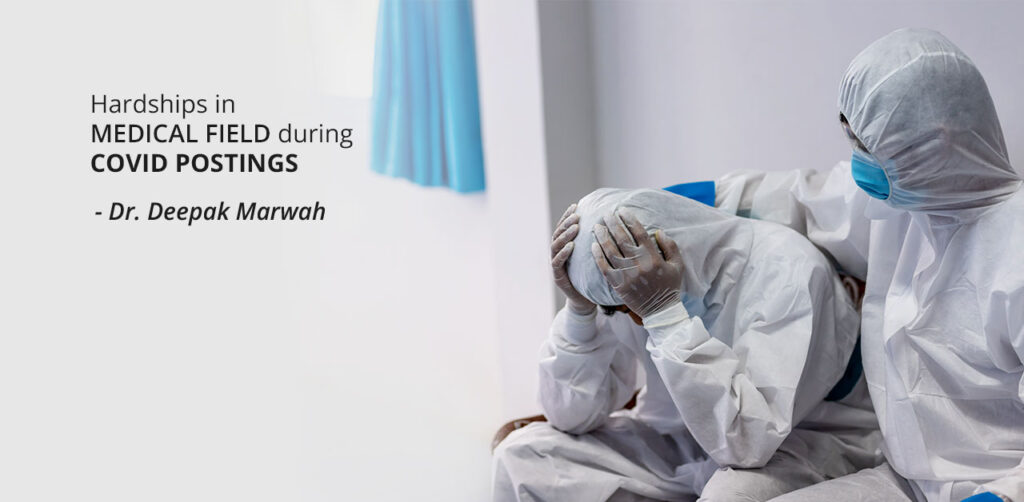
Hardships in MEDICAL FIELD during COVID POSTINGS

Tired of all the expectations! Doctors are not just burdened with work but also with a ton of expectations, from patients, their families and society as well. You don’t get to begin your day in a brilliant coloured corporate boardroom hi-fiving a good-looking colleague. Rather you usually begin and even end your day talking to a gloomy looking patient telling you his sad story. Very often you are further burdened with the HOD asking you to run some random errands. Most of your days are spent running between the OPD and the IPD, trying to manage the never ending stream of patients. A regular day starts at 8 am with just a simple toast and tea. Breakfast is a luxury you haven’t had time for several years. Sometimes the days begin even earlier than 8 am or the long night shift never ends. Well, let’s face it; we have all gone through the daily grind of being a doctor, faced our fair share of expectations, and powered through the rough days. Mostly we still manage to come out of all this smiling. First of all, becoming a doctor is not a joke and requires extreme mental and physical fitness. Ordinary people can’t hold their bladder for 2 hours. Ever seen the queue outside the toilet in the 2-hour Delhi Hyderabad flight, while you hold it for 10 hours in the operation theatre? So relax, you are a class apart. You’re the one delivers a baby aboard an indigo flight while the mindless airline staff takes selfies with a preterm 1.5Kg baby without ensuring basic hygiene. Hence, worsening the risk for COVID-19 transmission. So, the first message of this write up is: BEING a DOCTOR is not a JOKE and these internet educated people are sissies, simply looking for some masala and sympathy. For them Homeopathy is good despite no evidence of its efficacy and inspite of the fact that Lancet called it the biggest scam of the century. These dumb heads would rather believe a smooth-talking baba than science and evidence. They actually deserve what the government gives them i.e. no hospital beds and no health care. However, in the face of all this frustration and anger we might be feeling, let’s not forget that there is a meaning behind all this. Somebody on this planet has to volunteer and gear up to reduce the misery being spread by politicians and people alike. Like Lord Shiva, someone has to drink the poison and you’re the one doing it. Surrender is not the way. Your HOD may be cumbersome, the consultants selfish and self-absorbed but you mustn’t let these selfish and inferior people force you to give up. You must rise and shine for a bigger purpose and that is to make your mother and country proud. You’re the pillar upholding this ramshackle of a heath infrastructure that is crumbling. While the MLA of your district enjoys a bevy of official cars and a luxurious office, the poor District Medical Officer sits in a non-descript building without any air conditioning, doing so much paper work apart from finishing an OPD of 200 desperate people who have nowhere to go. If these people go to the police station they are beaten and if they go to the politician they fear being murdered. So, they go and vent their frustration at a poor and studious 24-year-old MBBS doctor. Not that you need to take any non-sense, but showing a bit of empathy will surely help you reduce your stress level and remedy the angst of the hostile and low IQ homosapiens. The COVID-19 situation has been a whirlpool of death and equivalent to near extinction. You are one of those brave soldiers who are fortunate enough to have been selected for the mission to defeat the virus. Perhaps, that’s the reason you take all the crap from your seniors, while sacrificing your personal well being, going to duty in a PPE kit on an empty stomach. This is not a joke. None of the non-medicos have the attitude, physical and mental capability required to wear this battle gear. You’re a class apart, a cut above the rest. You’re a doctor who must not accept nonsense. Your beliefs are rooted in giving it back when the situation demands. Instead of being angry at a poor patient, make the pseudo intellectuals cry. This is a flat line ECG. It takes 5 and half years to understand the basics of this. And yet, a 12th fail’s relatives barge in only to ask you to take body temperature as body is warm. They have no shame in beating the doctor up and in damaging hospital property. In such an event, all legal provisions must be used and non bailable warrants issued against the culprits. To cut the long story short, the take home message for a young and dashing doctor is: You’re born to drink poison and reduce the suffering of the poor and downtrodden. You are mentally and physically superior. Under any circumstances don’t try to hurt your-self. Your parents and loved ones are more important than everything else. Talk to your parents daily, even if it’s only for a couple of minutes after the end of your shift. Don’t rush during the removal of your PPE kit. Ensure that you use the sanitizer liberally and allow it to air dry. Thanks for reading all my rambling in this crazy time. Love you all! Dr. Marwah

Medical, Medicine classes

How to effectively use the Rapid revision program to increase your Strike rate?

Imagine you are a month away from the exam day, your social media feed is full of stressful comments and you feel uncomfortable no matter what you do. Self-doubt creeps up on you. You start questioning your preparation, doubting whether you are on the right track and feeling as if everyone’s ahead of you in the game. You feel as if you are being left behind. STOP! It’s time to go into INTERNET DARKNESS MODE and stop the internet feed from taking over your brain and demeaning your efforts. It is now time for Rapid Revision and nothing is going to stop you from getting to your target. Complete the entire Internal Medicine RR series in 3 days@ 5hours. For each session minimum continuous sitting advised is of 3-4 hours. This is in keeping with the exam duration i.e. 3 hours plus the 15-30 minutes time before exam, when you reach the exam hall and wait for the exam to start. Keeping your study sessions of similar duration will help you build stamina for sitting that long and being able to concentrate. If you feel fatigue in back muscles and strain in eye muscles after 2 hours of continuous sitting in front of the laptop it means that your physical fitness is not up to the mark. Use the months until the exam to practice and improve. Write down summary of each topic in max five points. Keep a separate 50-page register for this. Focus especially on comparisons, for example multifocal atrial tachycardia versus Atrial Fibrillation, Multiple Sclerosis versus Neuromyelitis Optica. The combination of Audio-visual stimulus along with quick jotting down of important points will prep up your neo-cortex with lots of information to be deployed in the final battle in the examination. The entire list of antibodies mentioned in the Rheumatology section have to be crammed up straight, as it does not need much understanding and if asked during the exam, your eyes should be hunting for the correct option. Some path slides have been incorporated to cover the integrated topics. For those where the path slides are mentioned make a note in the register and do those topics from Pathology RR as well on the same day. Even if you’ve to compromise on a few hours sleep, try to do those topics on the same day, as it will increase your retention of these integrated topics. On the fourth day, the following five lectures must be done at 1.5 X from the main app in the last month before the exam. Questions are always asked from these topics in any exam anywhere in the world. It will take less than half a day and the rest of the day can be dedicated to MCQ of multiple topics. Electrolyte imbalance (Kidney first lecture) Renal Tubular acidosis (Kidney) Epilepsy and EEG (neuro First lecture), AIDS (Last lectures in App) ECG and Arrythmias Keep in touch with your family. A comforting voice can change your mood and remind you that you are doing it to make your parents proud of your achievements. Focus on the positives. Do something apart from furiously scrolling Instagram or Facebook. This is important for your sanity. Those who post every hour on Facebook may be much less prepared than you are and only showing off. Never Show off and be humble. Best Wishes for the Final Battle. You can do this.

Medical, Medicine classes

Making an Effective Study Plan

Some tips to help you A study plan isn’t just a timetable, it’s much more than that. It details study goals, courses or syllabus to cover, time to be devoted to each, course material to study from, revision plans, tools to test your preparation, and more. Drawing a study plan helps you organize your time and thoughts better. It can help you stay focused, increase productivity, avoid mismanagement, and achieve your goals faster. Making an effective study plan can sound challenging. However, with some good planning and prioritization, you can come up with a handy study plan that enables you to accomplish your academic goals in an organized way. Well, before you start working on creating your study timetable, it is important to be aware of your learning style and your study potential. Also, you should consider and jot down all factors that can affect your study plan. We have listed below a few tricks and tips that can help you create an effective study plan. One way to make sure you get the best results in managing your study plan is to first collect all study material that you would need. You can collate your entire syllabus together from a reputed online study program provider and then use it effectively as per your need. Also, any books, class notes, or additional study material you may need, you should procure beforehand. Self evaluates and try to understand when and at what time of the day you are able to concentrate the most. This will help you to plan your daily routine in the best possible way. It is advisable to study during the daytime as all entrance exams are conducted during the day. If you are a night owl, try to slowly adapt and shift your study schedule to mornings as you wouldn’t want to be lethargic and unfocused during the actual exam. A handy study timetable consists of the variables like date and time with days of the week. You can hand draw a grid to prioritize your study schedule. Use colored highlighters to differentiate between weak and strong subjects, short and long subjects, etc. Divide your available time during a week into study blocks and then assign those blocks to a subject. This enables you to manage your time wisely without constantly checking. Start with 2 hours a day and then increase it gradually. This is an ideal way to go about it. The study is inevitably your key priority. However, it is important to take rest. To stay fresh and ensure complete concentration, it is advisable to take a power nap for an hour during the afternoon, after lunch. Pursuing your study schedule on a regular basis enables you to meet your academic goals. But, it is also vital to understand your requirements and make amendments accordingly. Once, you are aware that you understand a specific subject and need less time to study it than you should move on to another subject. By doing this, you can balance your study in a planned way. Creating your study plan in an easy-to-understand manner is another way to give a balanced approach to all subjects. The right way to go about it is to color-code all subjects so that you know which subject is easier and requires less study time and which subject is tougher and needs more study time. Prioritizing the subjects and courses, you need to study for within a certain amount of time is harder than you think. Therefore, it is advisable to finish one subject in a week and then move towards the second one instead of studying all at one time. Revision is the most important aspect of your study. During the first revision, it is better to revise two subjects in a day as that makes more sense. Following these tips and tricks, will surely help you achieve your academic goals. So, start creating your study timetable if you are looking to crack UG or PG entrance exams.

3 tips
Medicine, NEET PG

3 Tips to help you tackle Multiple Choice Exams

Multiple choice exams can be quite tricky, especially when you’re in a race against time. However, with a bit of strategy and planning, you can take on multiple choice questions with confidence and ease. Here are three tips to help you improve your performance in MCQ exams. Eliminate the Wrong The smartest way to tackle Multiple Choice Exams is by eliminating the obviously wrong options first. A typical MCQ has 3 wrong options and 1 correct option. It is way easier to detect the wrong answers than figuring the right one. Most MCQs are set up in such a way that two choices are straight out wrong, one is there to trick you, and one is correct. When you narrow down your choices, you greatly increase your chances of choosing the right answer. It has been rightly said that MCQ exams have more to do with eliminating wrong options than finding the right ones. Always be Extra Careful When you’re giving a lengthy Multiple Choice Exam your brain tends to get tired and you end up making careless mistakes. MCQ exams are notorious for tricking you into making mistakes by giving you trick options which, at first, may appear to be the correct answer. Try to stay alert, and double-check your entire paper for silly mistakes and trick options. Going through the paper one last time before submission is the best way to deal with careless mistakes that may initially go unnoticed. Make Smart Guesses If there isn’t any negative marking, just make an educated guess. The good thing with MCQs is that there multiple ways to reach the correct answer. For example, if you’re struggling to remember the exact answer, try recalling related information instead. It’ll eventually lead you to the answer. Also pay close attention to words like always, not, never, etc. Conditional words are often used to trick and confuse you so tread with caution whenever you come across any such words. When you’re faced with ‘all of the above’ or ‘none of the above’ choices, do not choose ‘all of the above’ if you’re confident that even one of the options is incorrect. Similarly, if you’re sure that at least one of the options is correct, do not go for ‘none of the above’.

5 way to overcome
Medicine, Medicine classes

5 Ways to Overcome the Fear of Failing in Exams

Have you ever been so afraid of failing at an exam that you just skipped it altogether? Fear of Failure is paralyzing. It leads to missed opportunities, inactivity, and low self-esteem. But don’t let the fear of failing an exam take over your life. Here are 5 proven ways to help you overcome this fear and create a healthier mindset. Identify the Root Cause of your Fear Examine your negative beliefs. Where does your fear of exams originate from? Take some time, sit down and introspect. Ask yourself the tough questions. Is the fear legit? How did you develop this fear? Is it making your life better or worse? And finally, what is the real cause behind your fear of failing exams? Once you figure out the real reason behind your fear of failure, you’ll realize that it sounds silly and you’ve fretting over nothing. Examining your negative beliefs is not easy, and requires a lot of courage. But it is definitely worth doing if you want live your life to the fullest. Remind yourself that Failure is Temporary Failure may feel permanent but it is nothing more than a temporary setback. The consequences of failure are never as bad as you imagine. Always remember that failing an exam is nothing more than a road bump. It is not the end of your life. Instead try to look at failure as feedback. When you fail an exam, you get to analyze where you went wrong which helps you prepare better for the next attempt. Overcome all-or-nothing Mindset All-or-nothing thinking or perfectionism is away thinking that pushes you towards unrealistic goals. Perfectionism is often seen as a strength, but being too much of a perfectionist can sometimes lead to self-defeating thought patterns. Too much perfectionism may lead to anxiety, fear of failure, and low self-esteem among other mental health issues. If you’re struggling with perfectionism, start with slowly challenging your behavior. List down things you believe should be done perfectly. Next write the reasons why you believe that activity must be perfect. And at last, write down the consequences if things don’t turn out as planned. When you write things down, you’ll be able to see through your negative beliefs and tackle them with better understanding. Work towards building a Healthy Self-Esteem When you have healthy self-esteem, you don’t see failure as a dead end but as a stepping stone to success. Work of shifting your perspective. Failure is inevitable. Even the most brilliant brains have faced failure. And who said failure is a bad thing? Failure is actually a blessing in disguise. Failure, not a success, teaches you lessons worth learning Exams. Welcome failure. Befriend your fears. Only then can you overcome them. Start Exercising and Meditating Join a gym. Go on a run. Work-out. Exercise releases endorphins which are natural painkillers, and help you combat stress in a much healthier way. Meditation is a great way to calm your mind and prepare yourself to face your fears with courage. When you meditate, you free your mind from anxious thoughts and become much more aware of yourself and your surroundings. Your breathing slows down, your mind stops racing and your pulse rate drops to a healthier level.

Artboard 3
Medical, Medicine classes, NEET PG

3 ways to overcome afternoon drowsiness for Doctors preparing

For NEET PG entrance / NEXT examination While it is common for small children to take afternoon naps, we grown-ups cannot afford the same luxury. Research shows it is quite natural to experience drowsiness and lethargy during in the afternoon, around 8 hours after waking up. Drinking an extra cup of coffee may sound tempting, but it is certainly not the healthiest way to stay awake. While these hacks may help you temporarily ward off afternoon drowsiness, you may want to ensure there’s no underlying medical condition at play. Most young people don’t realize that this drowsiness can be symptom of iron or nutrient deficiency, insulin resistance or obstructive sleep apnea. No harm or shame in getting yourself evaluated rather than using quack remedies to ward off sleepiness. Today, I’m going to share with you 3 healthy ways to combat afternoon drowsiness and re-energize your body. Take a Power Nap Another great way to combat afternoon sluggishness is take a quick 20-minute power nap. Research proves that 20 minutes of afternoon sleep is way more restful than 20 minutes of extra sleep in the morning. Don’t look at FaceBook or Whatsapp during lunch which we normally do. That just saps our brain further. Say No to Canteen Food which is greasy and unhealthy. Either cook your self or order from a healthy restaurant. Processed food digests quickly, messes with your blood sugar levels, and leads to low energy levels. As someone struggling with afternoon sluggishness, you should avoid processed food at all costs. Instead opt for healthy, energizing meals which are rich in iron, lean protein and complex carbohydrates, for example: leafy green vegetables, lean meat, whole grains etc.

Scroll to Top