Marwah Medicine

Medical, NEET PG

Motor neuron disease and amyotrophic lateral sclerosis

In this post we’ll break down the major types of MNDs, compare their clinical features and highlight points crucial for competitive exams like NEET PG, INI-CET, and FMGE. Core issue is combination of UMN and LMN lesion findings coexistent in a same patient for ALS. Physicist Stephen hawking was the longest living survivor of this fatal disorder that ultimately causes demise due to diaphragmatic paralysis. As bonus tip learn differences between AIDP and CIDP in 2 minutes at the bottom of this article. Comparison of Major Motor Neuron Disease  Disease  UMN involvement  LMN involvement  Key features  Onset & Progression  Age of Onset  Prognosis  Amyotrophic lateral Sclerosis (ALS) √ √ Mixed signs: spasticity + fasciculations; bulbar signs common Gradual onset, relentless progression 40-70 years Fatal within 3-5 years ( respiratory failure) Primary Lateral Sclerosis  √ X Pure UMN signs: spasticity, hyperreflexia, Babinski sign: no fasciculations Very slow progression >50 years Relatively benign Progressive muscular Atrophy (PMA) X √ Pure LMN signs; muscle wasting, fasciculations, flaccid weakness Gradual 30-60 years Better than ALS but can evolve into ALS Spinal muscular Atrophy (SMA) X √ Symmetrical LMN weakness, hypotonia, tongue fasciculations (esp. in infants) Depends on type (infantile to adult) Infancy to adulthood Varies (SMA type I is fatal in infancy) Progressive Bulbar Palsy  √ (bulbar UMNs) √ (bulbar LMNs) Dysarthria, dysphagia, tongue atrophy, emotional lability Often progresses to ALS 40-70 years Poor Pseudobulbar Palsy  √ X Dysarthria, dysphagia, emotional lability, but no tongue wasting or fasciculations Often associated with bilateral stroked / MS Older adults Variable   Key Clinical Differences  ALS (Amyotrophic lateral sclerosis) Hallmark: Combination of UMN and LMN signs in multiple regions Buzzwords: Fasciculations + spasticity: tongue atrophy; split hand sign PLS (Primary Lateral Sclerosis)  Hallmark: Pure UMN involvement Clue: No Fasciculations or muscle wasting PMA ( Progressive Muscular Atrophy Hallmark: Pure LMN disease Buzzwords: Muscle atrophy, areflexia, fasciculations, no spasticity May progress to ALS over time. SMA (Spinal Muscular Atrophy)  Genetics: Autosomal recessive, SMN1 gene mutation Types: Type I (Werdnig-Hoffmann): Infantile, floppy baby, fatal in 1st year Type II: Childhood onset Type III: (Kugelberg-Welander): Adolescent / adult onset Type: IV: Adult form, mildest   Progressive Bulbar Palsy Vs Pseudobulbar Palsy  Feature  Progressive Bulbar  Pseudobulbar  Site CN IX – XII (LMN) UMN to bulbar nuclei Tongue Atrophy, fasciculations Small spastic, no atrophy Reflexes Absent gag reflex Exaggerated jaw jerk Emotional lability Present Present Association May be variant of ALS Often bilateral strokes /MS   Important Exam Points  Most common MND: ALS ALS Affects both UMN and LMN – a key distinguishing feature Fasciculations + spasticity: Think ALS Tongue fasciculations in infants: Think SMA type I No sensory involvement is typical in MNDs. Frontotemporal dementia may coexist with ALS (especially C9 or F72 mutation) Riluzole is the only FDA – approval drug for ALS – prolongs survival by ~3 months. Recent Advances  Risdiplam for SMA Type: Oral SMN2 splicing modifier Mechanism: Increases production of functional SMN protein via enhanced SMN2 splicing Route: Oral syrup taken daily Age: Approved for infants (>2 months), children, and adult Gene therapy for SMA (Type I) with nusinersen and onasemnogene abeparvovec has revolutionized prognosis in children. Edaravone has been added as a treatment option in some ALS cases.   Bonus Tip  Comparison: AIDP vs CIDP Feature AIDP (Acute Inflammatory Demyelinating Polyradiculoneuropathy) CIDP (chronic Inflammatory Demyelinating Polyradiculoneuropathy)  Full form  Acute inflammatory demyelinating polyradiculoneuropathy Chronic Inflammatory Demyelinating Polyradiculoneuropathy Type  Most common variant of GBS Chronic form Onset Acute (subtype of GBS) Chronic (≥ weeks) Progression  Rapid (Similar to GBS) Slowly progressive or relapsing Weakness Ascending symmetric Similar but slower, often proximal and distal Reflexes  Absent or decreased Absent or decreased CSF Same as GBS Same ( mildly elevated protein, low WBC) Nerve Conduction  Demyelinating Demyelinating Treatment  IVIG or plasmapheresis Steroids IVIG, plasmapheresis (long -term)  

Medical

Meet the new detective of the nerve world: MRI Neurography!

Handling patients with Prolapsed intervertebral disc and offering them gabapentin for years is what we are doing for decades now. Have you ever wished you could literally follow a nerve along its winding path and catch it in the act of being compressed, inflamed, or injured? Well, MRI Neurography does just that—it’s like Sherlock Holmes for your nervous system! While traditional MRI is great for bones, muscles, and brain tissue, it often misses the subtle screams of your peripheral nerves. That’s where MRI Neurography swoops in like a superhero with a magnifying glass, zooming into every twist and turn of the nerve. Just think of it like switching from a grainy black-and-white TV to full-blown 4K ultra-HD for your nerves. What Exactly Is MRI Neurography? MRI Neurography is a cutting-edge imaging technique that allows doctors to visualize nerves with incredible clarity—especially the peripheral nerves, like the sciatic nerve, brachial plexus, or facial nerve. It uses high-resolution MRI sequences to highlight nerves and distinguish them from nearby muscles, vessels, and fat. This technique uses T2-weighted images with fat suppression, and often 3D STIR (Short Tau Inversion Recovery) sequences, to make abnormal nerves light up like glow sticks in a dark room. If there’s swelling, fibrosis, or compression—it’ll show up. In short MRI Neurography is the best modality for visualizing peripheral nerve disorders—especially in cases where EMG/NCV or standard MRI gives inconclusive results. From catching a tiny nerve root avulsion to highlighting a subtle perineural mass, this technique changes the game in neurology, orthopaedics, and pain medicine. When Do We Use MRI Neurography? If someone’s struggling with unexplained pain, numbness, tingling, or weakness—and standard MRI or EMG just isn’t giving answers—MRI Neurography is the go-to move. Clinical Indications for MRI Neurography   Example Use case Branchial or lumbosacral plexopathy   Post traumatic or radiation induced plexus injury Nerve entrapment syndrome   Carpal tunnel or piriformis syndrome Nerve trauma Sciatica or radial nerve damage   Nerve sheath tumours Schwannoma or neurofibroma   Chronic neuropathies Diabetic neuropathy, CIDP     Procedural details Patients lie in a standard MRI machine, but the software sequences are different. Special coils and 3D fat-suppressed images are used. Often, a contrast agent like Gadolinium is given to light up inflammatory or neoplastic areas. And voila—those nerves are on full display! Take home message: MRI neurography superiority over MRI in lieu 1.      Nerve visualization 2.      Nerve inflammation 3.      Anatomical reconstruction 4.      Clinical specificity    

5 ways to overcome
Antibiotics, Medical, Medicine

5 Ways to Overcome Overthinking and self-criticism

For doctors who are programmed into doing so from the first year of medical college Overthinking is when you do excessive thinking but never take any real action. It leads to unneeded stress and creates problems that didn’t even exist in the first place. It robs the joy out of the present moment. 5 Ways to overcome overthinking and self-criticism And what’s worse is that once you spiral into overthinking, it becomes really hard to come out of its ugly trap. But today I’m going to share with you 4 ways that not only stop overthinking but also encourage self-reflection and problem-solving. 5 Ways to Overcome Overthinking and self-criticism 1. Always Note down Negative Thoughts Writing about your negative thoughts and emotions can be quite therapeutic. It slows down ruminating thoughts and helps you better analyze your situations. When you write down your worries, you may even find that you have been stressing unnecessarily over silly things. When sit down to write, start by asking yourself how you’re feeling, why you’re feeling that way and how can you work to change it. These questions will help you slow down your mind, focus on your situation, and think clearly for solutions. 2. Go for a run or do some squats Physical exercise is a proven way to fight stress and anxious thoughts. When you work-out, your body releases endorphins which are natural painkillers and mood enhancers. Even clinical trials have verified that physical exercise can help fight depression and anxiety. 3. Start Living in the Present Almost all overthinking is caused by living in a moment other than the present. Instead focus on what’s happening right now. Make every hour count by learning a new topic or solving more questions. Use Social media only for limited time daily. 4. Practice Meditation Research shows that even a few minutes of mediation every day can have a profound impact on your life. And you don’t even need to do anything intricate. Just close your eyes and focus on breathing slowly. 5. Start using a Calendar Most smartphones are now equipped with calendar apps (think google calendar) that help you manage your time efficiently. Using a calendar may, at the beginning, look tedious but it is the best way to organize your time. You can plan out which classes to attend, which subjects to dedicate more time to, and on which days you should appear for a GT.

Medical

Cytotoxic vs Vasogenic Cerebral Edema – key Differences

Questions on types of cerebral oedema are frequent in NEET PG, INI-CET, and FMGE exams—often integrated in clinical scenarios involving trauma, stroke, tumors, or infections. Differentiating vasogenic vs cytotoxic edema is not just academic—it’s clinically relevant, radiologically distinct, and high-yield for MCQs. Feature Cytotoxic Edema Think neuronal Cell is swollen Vasogenic Edema Think Vascular leak   Etiology Ischemia, hypoxia, seizures Tumors, infections, trauma   Pathophysiology Failure of Na⁺/K⁺ ATPase due to hypoxia → intracellular sodium and water accumulation Disruption of the blood-brain barrier (BBB) → leakage of plasma and proteins into the extracellular space   Fluid Location Intracellular (inside neurons/ glia) Extracellular (interstitial space)   Imaging (DWI) Restricted diffusion (DWI bright, ADC dark) No true restriction (DWI May be normal or Mildly bright, ADC high)   Location Affects grey + white matter Affects white matter only, spares cortex   Response to steroids No benefit Responsive to steroids (e.g. peritumoral edema)   NCCT head Notice loss of gray and white matter differentiation Notice the finger like projection appearance due to exclusive white matter differentiation   Image credits and source: Radiopedia.com In a competitive exam like NEET PG, where every question matters, mastering the pathophysiology, imaging, and treatment implications of cerebral oedema can be the difference between a top rank and an average one.  

Artboard 3
Medical, Medicine classes, NEET PG

3 ways to overcome afternoon drowsiness for Doctors preparing

For NEET PG entrance / NEXT examination While it is common for small children to take afternoon naps, we grown-ups cannot afford the same luxury. Research shows it is quite natural to experience drowsiness and lethargy during in the afternoon, around 8 hours after waking up. Drinking an extra cup of coffee may sound tempting, but it is certainly not the healthiest way to stay awake. While these hacks may help you temporarily ward off afternoon drowsiness, you may want to ensure there’s no underlying medical condition at play. Most young people don’t realize that this drowsiness can be symptom of iron or nutrient deficiency, insulin resistance or obstructive sleep apnea. No harm or shame in getting yourself evaluated rather than using quack remedies to ward off sleepiness. Today, I’m going to share with you 3 healthy ways to combat afternoon drowsiness and re-energize your body. Take a Power Nap Another great way to combat afternoon sluggishness is take a quick 20-minute power nap. Research proves that 20 minutes of afternoon sleep is way more restful than 20 minutes of extra sleep in the morning. Don’t look at FaceBook or Whatsapp during lunch which we normally do. That just saps our brain further. Say No to Canteen Food which is greasy and unhealthy. Either cook your self or order from a healthy restaurant. Processed food digests quickly, messes with your blood sugar levels, and leads to low energy levels. As someone struggling with afternoon sluggishness, you should avoid processed food at all costs. Instead opt for healthy, energizing meals which are rich in iron, lean protein and complex carbohydrates, for example: leafy green vegetables, lean meat, whole grains etc.

Medical

NEET PG vs INICET: Same Syllabus, Two Worlds Apart!”

Think NEET PG and INI-CET prep is the same just because the syllabus overlaps? Think Again. One exam throws you a straightforward question like, “Drug treatment for malaria on Day 2 with dosages?” The other presents a 6 line clinical stem with an image of a Giemsa stain and has multiple correct options. The examiners expect you to tell placenta accreta by looking at placenta to evaluate homer wright vs flexner wintersteiner rossetes.   INI-CET is the battleground for the thinkers, the pattern recognizers, the fast processors NEET PG rewards the image interpreters, the masters of repeat questions and factual clarity. So, how do you prepare differently for each? Which subjects should you double down on for AIIMS -style integrated shocks, and where should you focus for NEET’s smart scoring? This guide breaks it all down – from question styles and traps to subject – wise smart prep. Whether you’re aiming for the top rank in INI-CET or looking to crush NEET PG with speed and precision, this article will completely change the way you approach both exams. These two are the golden ticket to your financial freedom. It takes a lot of guts to persist for 5.5 years in medical collage. Now you need to up the game further and handle things better. INI-CET vs NEET PG: MCQ Pattern & Subject Focus Featured INI-CET NEET PG  Question pattern Conceptual, clinical, integrated and image-heavy Conceptual + Factual mix, with clinical vignettes Difficulty level High Moderate to high Image -Based questions 15-20% 25% -30% Integrated Questions Very common (across 2-3 subjects in one stem) Increasing trend, but less intense One – liners Super tricky and sticky ones Moderate number, especially in Biochemistry, Pharmacology, Microbiology Repeat questions Heavy on new formats of same concept example hypercalcemic crisis but asked in different scenarios Less frequent repeats Length of Questions Often lengthy clinical vignettes Moderate length; easier to read quickly Time pressure High – as time per Q is less, requires rapid thinking Moderate – balanced speed vs accuracy needed Numerical Qs/ Image Qs Lab values, CTs, X-rays, staining ECGs X-rays, CTs, derm images Negative Marking Yes Yes Number of Questions 200 Qs in 3 hrs 200 Qs in 3.5 hrs   Quick glance at subject -wise Focus: INI-CET vs NEET PG Subject INI-CET Focus Areas NEET PG Focus Areas Medicine Clinical case integration, rare diseases, ECGs, X-rays, neurology, rheumatology High-yield cases (MI, stroke, infections), guidelines- based management Surgery Recent updates (e.g, Hernia types), instruments, surgical anatomy Trauma, acute abdomen, hernia, wound healing Obs-Gynae Instrument ID, CTSs, syndromes, new protocols Labor stages, PPH, contraception, GTD Pediatrics Syndromes, growth charts, milestone charts, genetic diseases IMNCI, nutrition, vaccines, common infections Pathology Integrated with medicine (e.g. SLE histo + lab) Classic one-lines + integrated Qs Pharmacology New drugs, mechanisms, adverse effects in clinical setting Repeats: DOCs, side effects, antidotes Microbiology Lab diagnosis, integration with cases, images (stains, cultures) Organism + disease pairings, vaccines Biochemistry Enzyme defects, clinical case application Classical one – liners (e.g. glycogen storage diseases) Anatomy CT/MRI -based Qs, Neuroanatomy, embryo integration Brachial plexus, cranial nerves, surface anatomy Physiology CVS, neurophysiology, respiratory case scenarios Graphs ( lung volumes, action potential), easy recall Qs PSM Biostats, scoring systems, integrated screening guidelines Repeats: OR, RR, NHPs, vaccine schedules Short subjects Psychiatry, dermatology, radiology, anesthesia – often in image form High repeat value; direct and easy to score AIIMS signature areas Optics (ophthal), ENT instruments, NEET SS- style integrations Less common

Medical, Medicine classes

Making an Effective Study Plan

Some tips to help you A study plan isn’t just a timetable, it’s much more than that. It details study goals, courses or syllabus to cover, time to be devoted to each, course material to study from, revision plans, tools to test your preparation, and more. Drawing a study plan helps you organize your time and thoughts better. It can help you stay focused, increase productivity, avoid mismanagement, and achieve your goals faster. Making an effective study plan can sound challenging. However, with some good planning and prioritization, you can come up with a handy study plan that enables you to accomplish your academic goals in an organized way. Well, before you start working on creating your study timetable, it is important to be aware of your learning style and your study potential. Also, you should consider and jot down all factors that can affect your study plan. We have listed below a few tricks and tips that can help you create an effective study plan. One way to make sure you get the best results in managing your study plan is to first collect all study material that you would need. You can collate your entire syllabus together from a reputed online study program provider and then use it effectively as per your need. Also, any books, class notes, or additional study material you may need, you should procure beforehand. Self evaluates and try to understand when and at what time of the day you are able to concentrate the most. This will help you to plan your daily routine in the best possible way. It is advisable to study during the daytime as all entrance exams are conducted during the day. If you are a night owl, try to slowly adapt and shift your study schedule to mornings as you wouldn’t want to be lethargic and unfocused during the actual exam. A handy study timetable consists of the variables like date and time with days of the week. You can hand draw a grid to prioritize your study schedule. Use colored highlighters to differentiate between weak and strong subjects, short and long subjects, etc. Divide your available time during a week into study blocks and then assign those blocks to a subject. This enables you to manage your time wisely without constantly checking. Start with 2 hours a day and then increase it gradually. This is an ideal way to go about it. The study is inevitably your key priority. However, it is important to take rest. To stay fresh and ensure complete concentration, it is advisable to take a power nap for an hour during the afternoon, after lunch. Pursuing your study schedule on a regular basis enables you to meet your academic goals. But, it is also vital to understand your requirements and make amendments accordingly. Once, you are aware that you understand a specific subject and need less time to study it than you should move on to another subject. By doing this, you can balance your study in a planned way. Creating your study plan in an easy-to-understand manner is another way to give a balanced approach to all subjects. The right way to go about it is to color-code all subjects so that you know which subject is easier and requires less study time and which subject is tougher and needs more study time. Prioritizing the subjects and courses, you need to study for within a certain amount of time is harder than you think. Therefore, it is advisable to finish one subject in a week and then move towards the second one instead of studying all at one time. Revision is the most important aspect of your study. During the first revision, it is better to revise two subjects in a day as that makes more sense. Following these tips and tricks, will surely help you achieve your academic goals. So, start creating your study timetable if you are looking to crack UG or PG entrance exams.

Medical, Medicine classes

How to effectively use the Rapid revision program to increase your Strike rate?

Imagine you are a month away from the exam day, your social media feed is full of stressful comments and you feel uncomfortable no matter what you do. Self-doubt creeps up on you. You start questioning your preparation, doubting whether you are on the right track and feeling as if everyone’s ahead of you in the game. You feel as if you are being left behind. STOP! It’s time to go into INTERNET DARKNESS MODE and stop the internet feed from taking over your brain and demeaning your efforts. It is now time for Rapid Revision and nothing is going to stop you from getting to your target. Complete the entire Internal Medicine RR series in 3 days@ 5hours. For each session minimum continuous sitting advised is of 3-4 hours. This is in keeping with the exam duration i.e. 3 hours plus the 15-30 minutes time before exam, when you reach the exam hall and wait for the exam to start. Keeping your study sessions of similar duration will help you build stamina for sitting that long and being able to concentrate. If you feel fatigue in back muscles and strain in eye muscles after 2 hours of continuous sitting in front of the laptop it means that your physical fitness is not up to the mark. Use the months until the exam to practice and improve. Write down summary of each topic in max five points. Keep a separate 50-page register for this. Focus especially on comparisons, for example multifocal atrial tachycardia versus Atrial Fibrillation, Multiple Sclerosis versus Neuromyelitis Optica. The combination of Audio-visual stimulus along with quick jotting down of important points will prep up your neo-cortex with lots of information to be deployed in the final battle in the examination. The entire list of antibodies mentioned in the Rheumatology section have to be crammed up straight, as it does not need much understanding and if asked during the exam, your eyes should be hunting for the correct option. Some path slides have been incorporated to cover the integrated topics. For those where the path slides are mentioned make a note in the register and do those topics from Pathology RR as well on the same day. Even if you’ve to compromise on a few hours sleep, try to do those topics on the same day, as it will increase your retention of these integrated topics. On the fourth day, the following five lectures must be done at 1.5 X from the main app in the last month before the exam. Questions are always asked from these topics in any exam anywhere in the world. It will take less than half a day and the rest of the day can be dedicated to MCQ of multiple topics. Electrolyte imbalance (Kidney first lecture) Renal Tubular acidosis (Kidney) Epilepsy and EEG (neuro First lecture), AIDS (Last lectures in App) ECG and Arrythmias Keep in touch with your family. A comforting voice can change your mood and remind you that you are doing it to make your parents proud of your achievements. Focus on the positives. Do something apart from furiously scrolling Instagram or Facebook. This is important for your sanity. Those who post every hour on Facebook may be much less prepared than you are and only showing off. Never Show off and be humble. Best Wishes for the Final Battle. You can do this.

Medical, Medicine classes

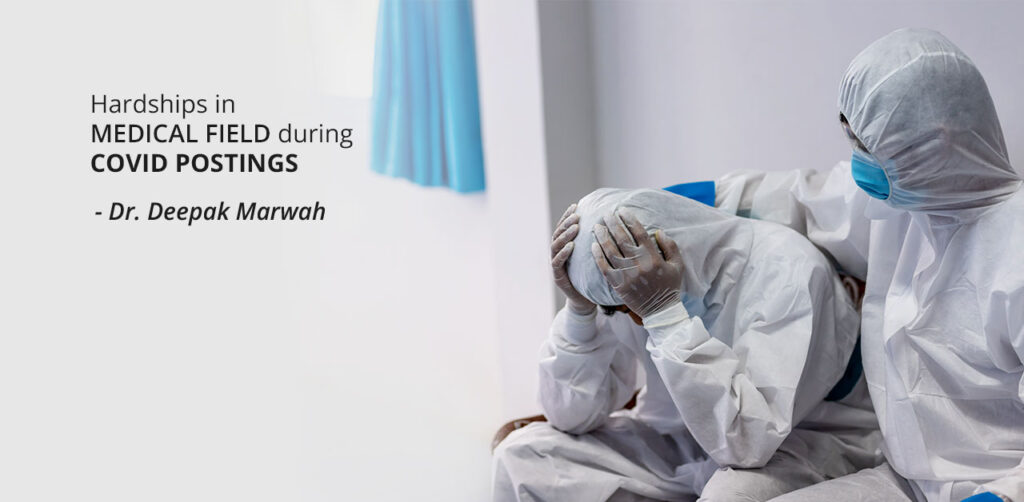
Hardships in MEDICAL FIELD during COVID POSTINGS

Tired of all the expectations! Doctors are not just burdened with work but also with a ton of expectations, from patients, their families and society as well. You don’t get to begin your day in a brilliant coloured corporate boardroom hi-fiving a good-looking colleague. Rather you usually begin and even end your day talking to a gloomy looking patient telling you his sad story. Very often you are further burdened with the HOD asking you to run some random errands. Most of your days are spent running between the OPD and the IPD, trying to manage the never ending stream of patients. A regular day starts at 8 am with just a simple toast and tea. Breakfast is a luxury you haven’t had time for several years. Sometimes the days begin even earlier than 8 am or the long night shift never ends. Well, let’s face it; we have all gone through the daily grind of being a doctor, faced our fair share of expectations, and powered through the rough days. Mostly we still manage to come out of all this smiling. First of all, becoming a doctor is not a joke and requires extreme mental and physical fitness. Ordinary people can’t hold their bladder for 2 hours. Ever seen the queue outside the toilet in the 2-hour Delhi Hyderabad flight, while you hold it for 10 hours in the operation theatre? So relax, you are a class apart. You’re the one delivers a baby aboard an indigo flight while the mindless airline staff takes selfies with a preterm 1.5Kg baby without ensuring basic hygiene. Hence, worsening the risk for COVID-19 transmission. So, the first message of this write up is: BEING a DOCTOR is not a JOKE and these internet educated people are sissies, simply looking for some masala and sympathy. For them Homeopathy is good despite no evidence of its efficacy and inspite of the fact that Lancet called it the biggest scam of the century. These dumb heads would rather believe a smooth-talking baba than science and evidence. They actually deserve what the government gives them i.e. no hospital beds and no health care. However, in the face of all this frustration and anger we might be feeling, let’s not forget that there is a meaning behind all this. Somebody on this planet has to volunteer and gear up to reduce the misery being spread by politicians and people alike. Like Lord Shiva, someone has to drink the poison and you’re the one doing it. Surrender is not the way. Your HOD may be cumbersome, the consultants selfish and self-absorbed but you mustn’t let these selfish and inferior people force you to give up. You must rise and shine for a bigger purpose and that is to make your mother and country proud. You’re the pillar upholding this ramshackle of a heath infrastructure that is crumbling. While the MLA of your district enjoys a bevy of official cars and a luxurious office, the poor District Medical Officer sits in a non-descript building without any air conditioning, doing so much paper work apart from finishing an OPD of 200 desperate people who have nowhere to go. If these people go to the police station they are beaten and if they go to the politician they fear being murdered. So, they go and vent their frustration at a poor and studious 24-year-old MBBS doctor. Not that you need to take any non-sense, but showing a bit of empathy will surely help you reduce your stress level and remedy the angst of the hostile and low IQ homosapiens. The COVID-19 situation has been a whirlpool of death and equivalent to near extinction. You are one of those brave soldiers who are fortunate enough to have been selected for the mission to defeat the virus. Perhaps, that’s the reason you take all the crap from your seniors, while sacrificing your personal well being, going to duty in a PPE kit on an empty stomach. This is not a joke. None of the non-medicos have the attitude, physical and mental capability required to wear this battle gear. You’re a class apart, a cut above the rest. You’re a doctor who must not accept nonsense. Your beliefs are rooted in giving it back when the situation demands. Instead of being angry at a poor patient, make the pseudo intellectuals cry. This is a flat line ECG. It takes 5 and half years to understand the basics of this. And yet, a 12th fail’s relatives barge in only to ask you to take body temperature as body is warm. They have no shame in beating the doctor up and in damaging hospital property. In such an event, all legal provisions must be used and non bailable warrants issued against the culprits. To cut the long story short, the take home message for a young and dashing doctor is: You’re born to drink poison and reduce the suffering of the poor and downtrodden. You are mentally and physically superior. Under any circumstances don’t try to hurt your-self. Your parents and loved ones are more important than everything else. Talk to your parents daily, even if it’s only for a couple of minutes after the end of your shift. Don’t rush during the removal of your PPE kit. Ensure that you use the sanitizer liberally and allow it to air dry. Thanks for reading all my rambling in this crazy time. Love you all! Dr. Marwah

FMGE, INICET, Medical

Pseduohypoparathyroidism vs Pseudopseudohypoparathyroidsm

Understanding this distinction is important for proper diagnosis, as it helps differentiate between these two genetically related conditions with similar physical manifestations but differing biochemical profiles. Pseudopseudohypoparathyroidism PPHP is caused by heterozygous mutations in the GNAS gene, the same gene responsible for PHP, but only in the paternal allele. Maternal allele of the GNAS gene is normal, so the gene function is not impaired in the tissues where the mutation is expressed (such as kidneys, bones, and adipose tissue). This results in the physical features of PHP (e.g., short stature, round face, and obesity) but without the biochemical abnormalities associated with PHP).   Key Features of PPHP: Physical Features: Individuals with PPHP often have the same physical features as those with PHP (e.g., short stature, obesity, round face, and sometimes subcutaneous calcifications). These features are due to the imprinting of the GNAS gene, which results in Albright’s hereditary osteodystrophy. Biochemical Features: In contrast to PHP, individuals with PPHP do not have PTH resistance. They do not experience the same hypocalcemia or elevated PTH associated with PHP. Urinary cAMP levels in response to PTH are normal in PPHP, because there is no resistance to the effects of PTH. This is one of the major distinguishing features between PHP and PPHP. Pseudohypoparathyroidism (PHP) vs Pseudopseudohypoparathyroidism (PPHP): Feature Pseudohypoparathyroidism (PHP) Pseudopseudohypoparathyroidism (PPHP) Cause Maternal inheritance of a mutation in the GNAS gene. Paternal inheritance of a mutation in the GNAS gene. Physical features Albright’s hereditary osteodystrophy (short stature, obesity, round face, subcutaneous calcifications). Same physical features (short stature, obesity, round face) as PHP. PTH levels Elevated PTH (due to PTH resistance in the kidneys and other tissues). Normal PTH levels because tissues respond normally to PTH. Urinary cAMP response to PTH Low or absent urinary cAMP despite elevated PTH levels (due to PTH resistance). Normal urinary cAMP response to PTH (because there is no PTH resistance). Calcium levels Hypocalcemia (low calcium) due to PTH resistance. Normal calcium levels (since there is no PTH resistance).   Key Diagnostic Difference: PPHP presents with the physical features of pseudohypoparathyroidism, but urinary cAMP levels will be normal in response to PTH, differentiating it from pseudohypoparathyroidism where urinary cAMP is low despite high PTH.   Take home points Pseudohypoparathyroidism (PHP) is characterized by PTH resistance and low urinary cAMP despite high PTH levels. Pseudopseudohypoparathyroidism (PPHP) shares the physical features of PHP (due to imprinting of the GNAS gene) but does not have PTH resistance, and urinary cAMP levels remain normal in response to PTH.

Scroll to Top