
The tragic death of Spanish footballer Jesús de Miguel—and the electrical accident every medical student should understand.
The moment football stopped
Ninety minutes of football. The scoreboard read 2–2. The match between CD Tenerife and FC Andorra was deep into added time on 2 November 2026 when striker Jesús de Miguel chased a loose ball near midfield. Goalkeeper Jesús Owono had raced out to challenge for it. The two collided; reports describe a forceful impact to de Miguel’s chest. He went down, medical staff rushed onto the pitch, and the match was abandoned. This was no longer about a result.
De Miguel, 30, was taken to hospital after a reported cardiac arrest. His circulation was reportedly restored during emergency care, but his neurological condition later deteriorated. Tenerife announced his death at 8 a.m. on 3 November. The Spanish football community mourned him with tributes across stadiums. [1–3]
Reports citing preliminary forensic findings point to accidental chest trauma; some subsequent reporting specifically raised commotio cordis. The complete forensic record and rhythm documentation have not been made public. It would therefore be inaccurate to call the precise arrhythmic mechanism definitively proved. But the case offers an urgent lesson in how chest trauma can cause sudden cardiac arrest. [2–4]
A strange possibility: the heart may be structurally normal
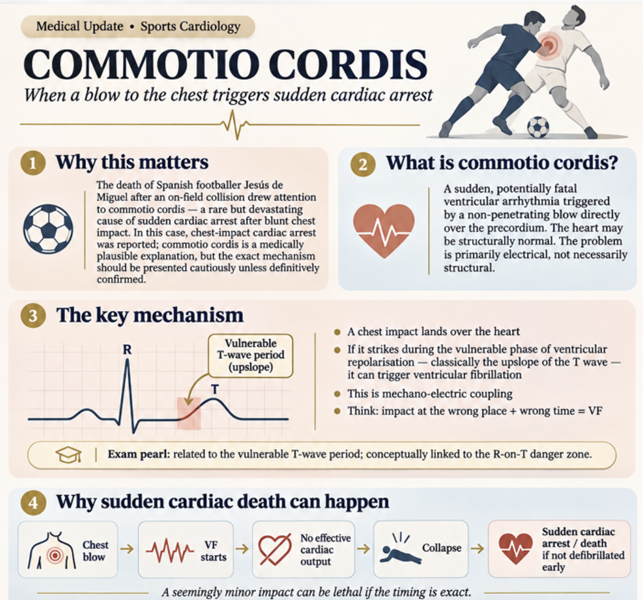
Most of us associate sudden cardiac death in an athlete with an abnormal heart: hypertrophic cardiomyopathy, arrhythmogenic cardiomyopathy, coronary anomalies or an inherited channelopathy. Commotio cordis is different. It is an abrupt, usually ventricular-fibrillation cardiac arrest triggered by nonpenetrating impact over the precordium during a brief electrically vulnerable phase of the cardiac cycle. The classic case has no pre-existing structural heart disease to explain the arrest. [5–7]
Think of it this way: the chest receives a mechanical blow, but the catastrophe is primarily electrical. A heart need not rupture, tear or even show major visible damage for a lethal arrhythmia to start. Nor does the person have to be an elite athlete. [5,6]
The few milliseconds that matter: why the T wave is the culprit
A normal heartbeat is a carefully timed electrical sequence. The QRS complex represents ventricular depolarisation. The T wave represents ventricular repolarisation. During a narrow interval around the early or ascending portion of the T wave, ventricular tissue is particularly vulnerable to a premature electrical disturbance.
If a blow arrives directly over the heart at just that moment, sudden myocardial deformation can activate mechanosensitive ion channels. The resulting abnormal current may trigger premature ventricular excitation and degenerate into ventricular fibrillation (VF). This interaction is called mechano-electric coupling. Experimental models demonstrate an especially narrow vulnerable interval, about 15 milliseconds in one well-studied animal model; clinical descriptions commonly refer to a window of roughly 20–40 milliseconds. [6–8]
For students: this is closely related to the concept behind the R-on-T phenomenon—a ventricular premature beat falling on the T wave, when repolarisation is vulnerable. In commotio cordis, however, the initiating stimulus is the chest impact; an actual R-on-T tracing is not required to make the clinical diagnosis, and no such tracing has been publicly documented in de Miguel’s case.
The correct conceptual chain is: chest impact over the heart → mechanical activation of cardiac tissue during vulnerable repolarisation → VF → loss of cardiac output → collapse.
Why is a seemingly ordinary impact dangerous?
Three elements must coincide: location, timing and impact characteristics. A blow directly over the precordium is particularly relevant. It has to arrive during a tiny part of the electrical cycle. The shape, speed and compliance of the impacting object can also affect the risk. Baseballs, softballs, lacrosse balls and hockey pucks have featured prominently in published cases, but footballs and player-to-player collisions have also been reported. [5–7]
Young athletes are disproportionately represented, partly because a younger chest wall is more compliant. That does not mean adults are immune. Equally, an especially violent collision may create structural thoracic injury—something that demands assessment on its own and must not automatically be labelled classical commotio cordis. [6,8]
Sudden cardiac arrest is not the same as a heart attack
Here is the viva trap. Cardiac arrest describes the sudden failure of effective circulation. Sudden cardiac death describes a fatal outcome after a cardiac event. Myocardial infarction is injury caused by myocardial ischaemia, usually from coronary artery obstruction. They are not synonyms.
In commotio cordis, the initial lethal event is typically VF: the ventricles quiver instead of contracting productively. Cerebral perfusion drops to nearly zero, and the person collapses. Hypoxic-ischaemic brain injury may develop if circulation cannot be restored promptly. An athlete can appear perfectly fit immediately before this happens. [5–7]
Could it have been something else? The differential matters
A collapse after chest trauma is a clinical emergency, not a retrospective diagnosis from a video. Other possibilities include cardiac contusion with arrhythmia, myocardial or chamber rupture, traumatic coronary injury, tension pneumothorax or major vascular injury. In athletes, a coincidental spontaneous arrhythmia from cardiomyopathy or channelopathy must also be considered.
Classical commotio cordis is generally a diagnosis supported by the sequence of precordial impact followed immediately by arrest, ideally a documented ventricular arrhythmia, and assessment excluding significant structural injury or another primary cardiac cause. Where the clinical and forensic records are incomplete, uncertainty should remain explicit. [6,8]
At the touchline: what actually saves lives?
A player collapses after a blow to the chest. Do not spend the first precious seconds debating whether the blow looked severe enough. If the person is unresponsive and is not breathing normally—or is only gasping—activate the emergency response, begin CPR and send immediately for an automated external defibrillator (AED). In India, call 112 for emergency assistance where available. [5,9]
For an adult, deliver high-quality compressions at 100–120 per minute, approximately 5–6 cm deep, allowing full recoil and minimising interruptions. Switch on the AED as soon as it arrives, attach the pads to the bare chest as shown on the diagrams, and follow its prompts; do not delay compressions while preparing the device. If VF or pulseless VT is identified, the AED will advise a shock. Resume CPR immediately as directed. [9]
Defibrillation does not ‘restart’ a stopped heart like an ignition key. It terminates chaotic electrical activity so organised rhythm can resume. Commotio cordis survival now exceeds 50% in contemporary reported series, largely because of rapid recognition, CPR and early defibrillation. Outcomes still vary, and a particular player’s outcome cannot be judged without access to the actual medical timeline. [5,7,8]
The exam hall version: five points to remember
- A nonpenetrating blow over the precordium can precipitate ventricular fibrillation even when the heart was structurally normal.
- The critical timing is vulnerable ventricular repolarisation—classically the ascending limb of the T wave.
- The mechanism is mechano-electric coupling, not necessarily anatomical cardiac rupture.
- Differentiate commotio cordis from myocardial contusion, coronary injury, cardiomyopathy and a primary channelopathy.
- Immediate CPR and early AED defibrillation are the decisive first responses.
A small clinical question before you leave
A 16-year-old cricketer is struck over the left precordium by a ball. He collapses immediately. The AED identifies ventricular fibrillation. An echocardiogram after successful resuscitation shows no structural abnormality. What is the most likely mechanism?
Answer: Commotio cordis—mechanically induced ventricular fibrillation following an impact during the vulnerable phase of ventricular repolarisation. Not myocardial infarction. Not a cardiac rupture. Not an inherited cardiomyopathy by default.
What this tragedy should change
A football ground should never depend on luck when a player collapses. Schools, coaching centres, stadiums and sports academies need a written cardiac emergency action plan, trained responders, a readily accessible AED and regular rehearsal. Screening may help identify some underlying heart diseases; it cannot reliably predict an electrical accident caused by a millisecond-timed impact. [5,9]
The death of Jesús de Miguel deserves to be remembered first as the loss of a young life, not merely as an examination vignette. Yet a clear understanding of chest-impact cardiac arrest can save the next athlete. When the heart suddenly stops, the most important people on the field may be those who recognise it, start compressions and bring the defibrillator.
References and reporting sources
- Agencia EFE. Fallece el delantero del Tenerife Jesús de Miguel tras el golpe que sufrió en el partido frente al Andorra. 3 Nov 2026. https://efe.com/deportes/2026-11-03/jesus-de-miguel-estado/
- AFP. Spanish footballer De Miguel dies after collision with keeper. 3 Nov 2026. https://www.afp.com/en/spanish-footballer-de-miguel-dies-after-collision-keeper
- The Guardian. In moments of pain, football comes together: Spain says goodbye to Jesús de Miguel. 5 Nov 2026. https://www.theguardian.com/football/2026/nov/05/jesus-de-miguel-death-tenerife-funeral-football-spain
- People. Cause of Death Revealed for 30-Year-Old Soccer Player. 6 Nov 2026. https://people.com/cause-of-death-revealed-for-soccer-player-30-who-collided-with-goalkeeper-mid-game-12237639
- American Heart Association. Commotio Cordis. Reviewed 24 Nov 2025. https://www.heart.org/en/health-topics/commotio-cordis
- Peng T, Derry LT, Yogeswaran V, Goldschlager NF. Commotio Cordis in 2023. Sports Medicine. 2023;53:1527–1536. https://pmc.ncbi.nlm.nih.gov/articles/PMC10356869/
- Maron BJ, Estes NAM. Commotio Cordis Returns…When We Least Expected It. Am J Cardiol. 2023;202:229–232. https://pubmed.ncbi.nlm.nih.gov/37495440/
- Revisiting Commotio Cordis: Novel Insight Into Clinical Variability, Diagnosis, Epidemiology, and Prevention. 2026. https://pubmed.ncbi.nlm.nih.gov/41717928/
- American Heart Association. 2025 Guidelines for CPR & ECC: Part 7, Adult Basic Life Support. https://cpr.heart.org/en/resuscitation-science/cpr-and-ecc-guidelines/adult-basic-life-support