
DKA, HHS & Lactic Acidosis in Diabetes Home DKA, HHS & Lactic Acidosis in Diabetes DKA, HHS & Lactic Acidosis in Diabetes Which is better...
Diabetes and Sexual Health
- Home
- Diabetes and Sexual Health
Diabetes and Sexual Health
Erectile Dysfunction, Low Libido and Female Sexual Dysfunction — A Practical 2026 Guide
Why sexual symptoms in diabetes deserve the same clinical attention as the heart, kidney, eye and foot.
Dr Deepak Marwah • MarwahMedicine.com • Updated October 2026
THE 20-SECOND ANSWER
Diabetes can impair sexual function through vascular disease, autonomic neuropathy, hormonal problems, medications, depression/anxiety, obesity and genitourinary complications.
In men, erectile dysfunction may be an early marker of cardiovascular disease. In women, diabetes is associated with problems involving desire, arousal, orgasm, lubrication and pain.
The 2026 ADA Standards recommend actively asking about sexual health in both men and women rather than waiting for the patient to raise the subject.
“Diabetes does not stop at the kidney, heart or retina. For many patients, one of its earliest — and least discussed — complications happens in the bedroom.”
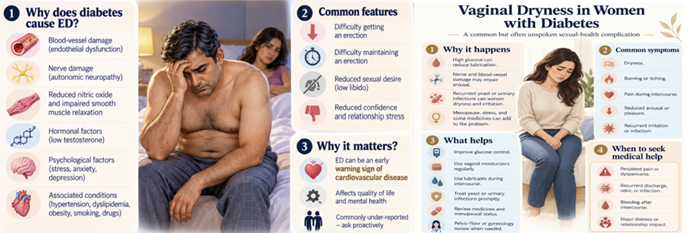
Why sexual health belongs in routine diabetes care
Sexual dysfunction is common in diabetes, yet it is often underdiagnosed because patients may feel embarrassed and clinicians may not ask. The American Diabetes Association (ADA) 2026 Standards explicitly place sexual health inside the comprehensive diabetes evaluation. [1]
This matters because a sexual complaint is not necessarily “just a quality-of-life issue.” Erectile dysfunction (ED) can be a clue to endothelial dysfunction and future cardiovascular risk; low libido may point toward depression, medication effects or hypogonadism; and vaginal dryness, pain or recurrent infections may reveal menopause-related or genitourinary problems that can be treated. [1–3]
How does diabetes affect sexual function?
Think of SIX overlapping mechanisms
- Vascular: endothelial dysfunction and atherosclerosis reduce genital blood flow.
- Neurologic: autonomic and peripheral neuropathy impair erectile, arousal and bladder/genital responses.
- Metabolic: persistent hyperglycemia, obesity, dyslipidemia and hypertension magnify vascular and hormonal dysfunction.
- Hormonal: obesity and diabetes are associated with lower testosterone in some men; menopause can intensify genitourinary symptoms in women.
- Psychological: depression, anxiety, diabetes distress, body-image concerns and relationship strain can reduce desire and performance.
- Treatment/comorbidity related: some drugs, chronic kidney disease, cardiovascular disease, recurrent UTI/genital infection and sleep disorders can contribute.
Men with diabetes: erectile dysfunction is the headline — but not the whole story
ED is the inability to achieve or maintain an erection sufficient for satisfactory sexual activity. ADA cites an estimated prevalence of about 52.5% among men with diabetes. Risk rises with age, longer diabetes duration, poor glycemic management, cardiovascular disease, kidney disease, retinopathy, autonomic/peripheral neuropathy, obesity, depression and hypogonadism. [1]
CLINICAL PEARL
New ED in a man with diabetes should trigger two parallel questions: “How do we restore sexual function?” and “What is his cardiovascular risk?”
ED is considered a cardiovascular risk marker/risk-enhancing factor, particularly when the cause appears vasculogenic. [1,3]
What should you ask?
- Onset, duration and consistency of the problem; morning/spontaneous erections; libido; ejaculation and orgasm.
- Chest pain, exertional dyspnea and exercise tolerance — because sexual activity is a cardiovascular stressor.
- Smoking, alcohol, sleep, physical activity, depression/anxiety and relationship factors.
- Medication review: antihypertensives, antidepressants, opioids and other drugs may contribute in selected patients.
- Symptoms of hypogonadism: reduced libido, loss of spontaneous erections, low energy, reduced muscle mass or infertility.
Practical work-up for ED in diabetes
| 1 | Confirm the phenotype Differentiate loss of desire from erectile difficulty; ask about spontaneous/morning erections and situational variability. |
| 2 | Check cardiometabolic risk Review blood pressure, smoking, weight, glycemia and lipids. Men with vasculogenic ED deserve cardiovascular risk assessment. |
| 3 | Look for diabetes complications Neuropathy, retinopathy, kidney disease and longer diabetes duration increase ED risk. |
| 4 | Test testosterone when indicated If low libido or other symptoms/signs of hypogonadism are present, obtain a morning total testosterone. A low result should be confirmed before diagnosing hypogonadism. |
| 5 | Escalate when atypical or refractory Severe deformity, pelvic trauma, endocrine red flags, neurologic disease or failure of appropriate first-line treatment may warrant urology/endocrinology evaluation. |
Low testosterone: do not diagnose it from symptoms alone
The ADA recommends morning serum total testosterone testing when a man with diabetes has symptoms or signs of hypogonadism. The Endocrine Society similarly emphasizes that hypogonadism requires BOTH compatible symptoms/signs and consistently low, accurately measured testosterone concentrations; a low morning value should be repeated to confirm the diagnosis. [1,4,5]
Do not use testosterone simply to “treat diabetes.”
Testosterone therapy may improve sexual symptoms in appropriately diagnosed hypogonadal men, but it is not recommended as a glucose-lowering strategy in type 2 diabetes. [4]
Fertility plans, prostate/breast disease, hematocrit, untreated severe OSA, recent major cardiovascular events and other contraindications/precautions must be reviewed before therapy.
Treating erectile dysfunction in diabetes: a practical ladder
Treatment works best when it addresses both the symptom and the vascular/metabolic environment that produced it.
| 1 |
Optimize the background Improve glycemic management, exercise, weight, smoking status, blood pressure, lipids, sleep and depression/anxiety. These steps also lower cardiovascular risk. |
| 2 |
PDE5 inhibitor is usually first-line Sildenafil, tadalafil and other PDE5 inhibitors are effective first-line therapies. Men with diabetes may respond less robustly than men without diabetes, so correct use and adequate trials matter. [1] |
| 3 |
NEVER combine a PDE5 inhibitor with nitrates The combination can cause dangerous hypotension. Princeton IV also advises attention to cardiac stability and exercise tolerance before ED treatment in higher-risk patients. [3] |
| 4 |
If response is poor, troubleshoot before declaring failure Check timing, dose use, sexual stimulation, adherence, testosterone deficiency when clinically suspected, and uncontrolled comorbidities. |
| 5 |
Second-line and specialist options exist Vacuum erection devices, intracavernosal/intraurethral therapies and penile prosthesis can be effective when oral therapy fails or is unsuitable. [1,2] |
Women with diabetes: desire, arousal, orgasm, dryness and pain all matter
Female sexual dysfunction (FSD) is common but much less frequently discussed. The ADA 2026 Standards recommend asking women with diabetes or prediabetes about desire (libido), arousal and orgasm difficulties, particularly when depression/anxiety or recurrent urinary tract infections are present. Postmenopausal women should also be screened for genitourinary syndrome of menopause (GSM), including vaginal dryness and dyspareunia. [1]
A simple symptom-to-cause map
| Symptom | Common contributors in diabetes | What to consider |
|---|---|---|
| Low desire | Depression/anxiety, relationship factors, medications, menopause, endocrine issues | Psychosocial review; medication review; menopausal/endocrine assessment when indicated |
| Poor arousal | Vascular/autonomic dysfunction, neuropathy, psychological factors | Cardiometabolic optimization; assess neuropathy and context |
| Dryness / pain | GSM, infection, inadequate lubrication | Examine for GSM/infection; lubricants/moisturizers; menopausal treatment when appropriate |
| Orgasm difficulty | Neuropathy, medications, mood disorders, relationship factors | Medication and neurologic review; address distress and relationship factors |
| Recurrent genital/urinary symptoms | Hyperglycemia, candidiasis/UTI, GSM; drug-related genital infection risk in some patients | Diagnose the actual cause; treat infection/GSM and review glycemic/drug factors |
What can help women?
Improve cardiometabolic health: nutrition, exercise, smoking cessation, weight management and better glycemic control can support sexual function and reduce complications.
• Treat depression, anxiety and diabetes distress rather than assuming the problem is purely hormonal.
• Address vaginal dryness and dyspareunia directly. Lubricants/moisturizers and, when appropriate, evaluation/treatment of GSM can make a major difference.
• Look for urinary tract and genital mycotic infections when symptoms suggest them; treat the cause rather than simply advising avoidance of sex.
• Selected women with diagnosed hypoactive sexual desire disorder may be candidates for approved therapies after appropriate evaluation; management is individualized.
Will better HbA1c reverse sexual dysfunction?
Better glycemic management is important because it reduces exposure to the metabolic environment that drives vascular and neuropathic complications. But established autonomic neuropathy or advanced vascular disease may not fully reverse simply because HbA1c improves. ADA notes that optimal glycemic management can prevent neuropathy in type 1 diabetes and may modestly slow progression in type 2 diabetes, but it does not reverse established neuronal loss. [2]
The practical message
Improve glucose — but do not tell a symptomatic patient to “wait until the HbA1c is better.”
Treat ED, GSM, infections, depression/anxiety, hypogonadism when present, and cardiovascular risk in parallel.
Do diabetes drugs themselves cause sexual dysfunction?
There is no simple “diabetes drug = low libido” rule. The more useful approach is to review the whole medication list and identify the actual mechanism. Some non-diabetes medicines — including certain antidepressants, opioids and cardiovascular drugs — can contribute to sexual symptoms in selected people. SGLT2 inhibitors can increase genital mycotic infection risk, which may indirectly disrupt sexual activity, but that is different from causing erectile dysfunction or low libido directly. Medication changes should be individualized rather than made reflexively.
Red flags: when sexual symptoms deserve urgent or specialist attention
- ED with unstable angina, decompensated heart failure, major exercise intolerance or other unstable cardiovascular symptoms — stabilize the cardiac condition before sexual activity/ED treatment. [3]
- PDE5 inhibitor use in a patient taking nitrates — contraindicated because of severe hypotension risk. [3]
- Markedly low testosterone confirmed on repeat testing, infertility concerns, pituitary/testicular signs or abnormal prolactin/LH/FSH — endocrine evaluation may be needed.
- Penile deformity, pelvic trauma, severe pain, neurologic red flags or refractory ED — consider urology.
- Postmenopausal bleeding, unexplained pelvic pain, lesions, recurrent unexplained genital/urinary symptoms or persistent dyspareunia — investigate rather than attributing everything to diabetes.
The Marwah 5-question sexual-health screen for diabetes
| 1 |
Desire Has your interest in sex changed? |
| 2 |
Function Any difficulty with erections, arousal, orgasm, lubrication or pain? |
| 3 |
Complications Any neuropathy, kidney disease, vascular disease, infections or urinary symptoms? |
| 4 |
Hormones & mood Symptoms of low testosterone, menopause/GSM, depression, anxiety or diabetes distress? |
| 5 |
Cardiac safety & medicines Any exertional symptoms? Nitrate use? Any medicines that could be contributing? |
ONE-LINE TAKE-HOME
Sexual dysfunction in diabetes is often vascular + neurologic + hormonal + psychological at the same time. The best care is therefore layered, not a single-pill solution.
Frequently asked questions
Can diabetes cause impotence?
Yes. Diabetes can cause ED through vascular disease, endothelial dysfunction and autonomic/peripheral neuropathy, with obesity, hypertension, dyslipidemia, depression and low testosterone sometimes adding to the problem.
Can ED be the first sign of cardiovascular disease?
It can be an early marker of vascular disease. Current consensus treats vasculogenic ED as a cardiovascular risk marker/risk-enhancing factor, so cardiovascular risk assessment should not be skipped.
Should every man with diabetes get a testosterone test?
No. ADA recommends a morning total testosterone when symptoms or signs of hypogonadism are present, such as low libido. A low value should be confirmed before diagnosing hypogonadism.
Can sildenafil or tadalafil be used in diabetes?
Often yes, and PDE5 inhibitors are first-line therapy for ED. But they must not be combined with nitrate drugs, and cardiovascular stability should be considered in higher-risk patients.
Does better glucose control cure ED?
It can reduce progression risk and improve the overall metabolic environment, but long-standing vascular or nerve damage may not fully reverse. Treat ED and risk factors in parallel.
Can diabetes affect sexual function in women?
Yes. Problems can involve desire, arousal, orgasm, lubrication and pain. Depression/anxiety, neuropathy, vascular disease, menopause/GSM and recurrent genitourinary problems may all contribute.
Is vaginal dryness in a woman with diabetes always due to diabetes?
No. In postmenopausal women, genitourinary syndrome of menopause is common and should be specifically assessed. Infection and other gynecologic causes also need consideration.
Can sexual health improve with weight loss and exercise?
Often. Lifestyle intervention improves cardiometabolic health and may improve sexual function, while also treating major upstream drivers such as obesity, vascular risk and depression.
Exam / clinic pearls
- Diabetic autonomic neuropathy can cause ED and retrograde ejaculation in men.
- ED in diabetes is not merely a sexual complaint — think cardiovascular risk.
- PDE5 inhibitors are first-line for ED; nitrates + PDE5 inhibitor is a dangerous combination.
- Low libido + diabetes does not automatically mean low testosterone. Diagnose hypogonadism with symptoms/signs plus consistently low levels.
- In women, ask about desire, arousal, orgasm, lubrication and pain — not just “any sexual problem?”
- Postmenopausal vaginal dryness + dyspareunia: think genitourinary syndrome of menopause.
- Better glycemic control is necessary, but established neuropathy may not reverse.
References
1. American Diabetes Association Professional Practice Committee. Comprehensive Medical Evaluation and Assessment of Comorbidities: Standards of Care in Diabetes—2026. Diabetes Care. 2026;49(Suppl 1):S77–S110. https://diabetesjournals.org/care/article/49/Supplement_1/S77/163931
2. American Diabetes Association Professional Practice Committee. Retinopathy, Neuropathy, and Foot Care: Standards of Care in Diabetes—2026. Diabetes Care. 2026;49(Suppl 1):S261–S287. https://diabetesjournals.org/care/article/49/Supplement_1/S261/163919
3. Miner M, et al. Princeton IV consensus guidelines: PDE5 inhibitors and cardiac health. J Sex Med. 2024;21(2):90–116. https://academic.oup.com/jsm/article/21/2/90/7499332
4. Bhasin S, et al. Testosterone Therapy in Men With Hypogonadism: An Endocrine Society Clinical Practice Guideline. J Clin Endocrinol Metab. 2018;103(5):1715–1744. https://www.endocrine.org/clinical-practice-guidelines/testosterone-therapy
5. Endocrine Society. Statement on Testosterone Replacement Therapy. July 16, 2026. https://www.endocrine.org/news-and-advocacy/news-room/2026/statement-on-testosterone-replacement-therapy
Other Related Links
- All Posts
- Antibiotics
- CLINICAL CASE QUESTIONS
- COPD
- COVID-19
- Etiquette
- FMGE
- GIST
- INICET
- Medical
- Medicine
- Medicine classes
- NEET
- NEET PG
- NEET PG 2025
- NEETPG2024
- NEETSS
- NExT
- NExT Exam
- Nymphomania
Metformin and Kidney Function Home Metformin and Kidney Function Metformin and Kidney Function eGFR Cutoffs, Dose Reduction and When to Stop — 2026 Practical Guide...
Semaglutide vs Tirzepatide for Type 2 Diabetes and Obesity Home Semaglutide vs Tirzepatide for Type 2 Diabetes and Obesity Semaglutide vs Tirzepatide for Type 2...
When to Start Insulin in Type 2 Diabetes Home When to Start Insulin in Type 2 Diabetes When to Start Insulin in Type 2 Diabetes:...
Finerenone in Diabetic Kidney Disease Home Finerenone in Diabetic Kidney Disease Finerenone in Diabetic Kidney Disease Who should get it in 2026? The diabetic patient...
Diabetes and Heart Failure: Best Glucose-Lowering Drugs in HFrEF and HFpEF (2026) Home Diabetes and Heart Failure The mistake: choosing a diabetes drug by HbA1c...
Diabetes Treatment Guidelines 2026 Home Diabetes Treatment Guidelines 2026 Diabetes Treatment Guidelines 2026: Is Metformin Still First-Line? A practical, evidence-based guide to choosing therapy by...