
DKA, HHS & Lactic Acidosis in Diabetes Home DKA, HHS & Lactic Acidosis in Diabetes DKA, HHS & Lactic Acidosis in Diabetes Which is better...
Semaglutide vs Tirzepatide for Type 2 Diabetes and Obesity
- Home
- Semaglutide vs Tirzepatide for Type 2 Diabetes and Obesity
Semaglutide vs Tirzepatide for Type 2 Diabetes and Obesity
Which is better in 2026 — and which patient should receive which drug?
Updated 30 October 2026 | For nonpregnant adults | Drug indications and availability vary by country
The 20-second answer
Tirzepatide generally produces the larger average reductions in A1C and body weight. Semaglutide remains a powerful choice and has especially mature cardiovascular and kidney outcome evidence in defined high-risk populations. In 2026, the best drug is not chosen by “which lowers A1C more?” alone — choose by obesity severity, ASCVD, CKD, heart failure phenotype, tolerability, access, patient preference and the exact approved indication.
The comparison has changed. Semaglutide is no longer simply “the strongest GLP-1 drug,” and tirzepatide is not merely “a better weight-loss injection.” The modern decision is phenotype-first: identify what outcome matters most for this patient, then choose the therapy with the strongest fit.
1. First, understand the mechanism
| Feature | Semaglutide | Tirzepatide |
|---|---|---|
| Drug class | GLP-1 receptor agonist | Dual GIP/GLP-1 receptor agonist |
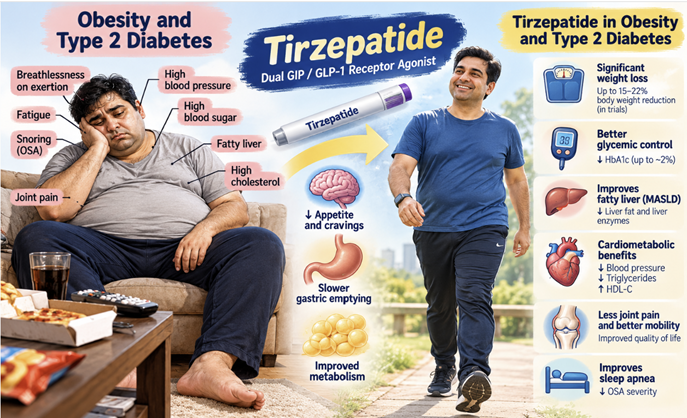
| Main metabolic effects | Glucose-dependent insulin secretion, lower glucagon, slower gastric emptying, increased satiety | GLP-1 effects plus GIP receptor activity; strong effects on glycemia, appetite and weight |
| Usual frequency | Once weekly injection for diabetes/obesity formulations; oral semaglutide also exists for diabetes | Once weekly injection |
| Hypoglycemia alone | Low | Low |
| Weight effect | Very high | Very high; on average greater in head-to-head obesity data |
Clinical pearl
Neither drug should be reduced to an “A1C drug.” Their value is metabolic and, depending on the agent and population, cardiovascular, kidney, liver and heart-failure related. The 2026 ADA/EASD consensus pushes GLP-1-based therapies earlier when they fit the patient’s long-term risk profile.
2. Type 2 diabetes: what did the direct head-to-head trial show?
| Outcome at 40 weeks | Tirzepatide 5 mg | Tirzepatide 10 mg | Tirzepatide 15 mg | Semaglutide 1 mg |
|---|---|---|---|---|
| Mean A1C change | −2.01% | −2.24% | −2.30% | −1.86% |
| Mean weight change | −7.6 kg | −9.3 kg | −11.2 kg | −5.7 kg |
| A1C <7% | 82–86% across tirzepatide doses | — | — | 79% |
Do not overinterpret SURPASS-2
The semaglutide comparator was 1 mg weekly, not the later 2 mg diabetes dose. So the trial proves superiority versus semaglutide 1 mg under its study conditions; it is not a direct tirzepatide-versus-semaglutide-2-mg trial.
3. Obesity: SURMOUNT-5 gave us the cleaner modern comparison
SURMOUNT-5 enrolled adults with obesity but without type 2 diabetes and compared maximum tolerated doses of tirzepatide (10 or 15 mg) with semaglutide (1.7 or 2.4 mg) for 72 weeks. This is the most relevant head-to-head trial when the primary goal is weight loss.
| 72-week outcome | Tirzepatide | Semaglutide |
|---|---|---|
| Mean body-weight change | −20.2% | −13.7% |
| Mean waist change | −18.4 cm | −13.0 cm |
| Primary conclusion | Superior for weight and waist reduction | Highly effective, but less mean loss in this trial |
| Most common adverse effects | GI; mainly mild to moderate during escalation | GI; mainly mild to moderate during escalation |
Bottom line for obesity
If the dominant objective is maximum average weight reduction and there is no overriding contraindication or access issue, tirzepatide has the strongest head-to-head efficacy signal. But “more weight loss” is not automatically “best for every patient.”
4. Which drug should I choose? Use the phenotype, not the hype
| Patient phenotype / priority | Practical 2026 direction | Why |
|---|---|---|
| Severe obesity; maximum weight-loss goal | Often favor tirzepatide | Head-to-head SURMOUNT-5 showed greater mean weight loss. |
| Type 2 diabetes with A1C far above target + obesity | Often favor tirzepatide | Very high glycemic efficacy plus strong weight effect. |
| Established ASCVD / obesity with prior CV disease | Semaglutide is particularly compelling where its proven outcome indication fits; tirzepatide is also reasonable when appropriate | Semaglutide has direct MACE reduction evidence in SELECT and established GLP-1 CV evidence; tirzepatide has now demonstrated CV noninferiority versus dulaglutide in SURPASS-CVOT. |
| Type 2 diabetes + albuminuric CKD | Semaglutide has especially strong dedicated kidney-outcome evidence; still layer SGLT2 inhibitor / finerenone when indicated | FLOW showed fewer major kidney outcomes and CV death with semaglutide in T2D + CKD. |
| Obesity-related symptomatic HFpEF | Either may fit depending on indication, evidence, access and patient profile | 2026 standards recognize GLP-1-based and dual GIP/GLP-1 therapies with demonstrated HFpEF benefits. |
| GI intolerance / patient cannot tolerate escalation | Choose the better-tolerated agent, slow titration, or use an alternative | Persistence matters more than theoretical maximum efficacy. |
| Cost / supply / access dominates | Use the effective agent the patient can actually obtain and continue | Chronic therapy only works if it is sustainable. |
5. Cardiovascular and kidney outcomes: this is where the nuance matters
Semaglutide has a particularly deep outcomes portfolio. In SELECT, semaglutide 2.4 mg reduced major cardiovascular events by 20% relative to placebo in people with overweight or obesity and established cardiovascular disease but without diabetes. In FLOW, semaglutide 1 mg reduced major kidney disease outcomes in adults with type 2 diabetes and CKD.
Tirzepatide’s cardiovascular evidence has also matured. SURPASS-CVOT enrolled patients with type 2 diabetes and established ASCVD and showed tirzepatide was noninferior to dulaglutide for cardiovascular death, myocardial infarction or stroke. Superiority was not demonstrated for the primary MACE comparison.
Exam-ready distinction
For pure metabolic potency, tirzepatide usually leads. For a patient in whom a specific proven cardiovascular or kidney outcome indication is the deciding factor, semaglutide may be the cleaner evidence-based choice. Always match the trial population to the patient in front of you.
6. Dosing and titration: the principle is “start low, go slow”
Both drugs are typically started at a low dose and escalated gradually to improve gastrointestinal tolerability. The exact maintenance dose depends on whether the indication is diabetes or obesity, the formulation, tolerability, local regulatory approval and patient response.
| Principle | Semaglutide | Tirzepatide |
|---|---|---|
| Starting concept | Low introductory dose, then stepwise escalation | Low introductory dose, then stepwise escalation |
| Dose escalation | Usually every 4 weeks if tolerated | Usually every 4 weeks if tolerated |
| If nausea is significant | Delay escalation; reassess meal size, hydration and other causes | Delay escalation; reassess meal size, hydration and other causes |
| If switching between agents | No validated mg-for-mg equivalence; avoid overlap and retitrate conservatively | No validated mg-for-mg equivalence; avoid overlap and retitrate conservatively |
Important
Do not “chase the maximum dose” in a patient already meeting metabolic goals with good tolerability. The goal is the lowest sustainable regimen that achieves the individualized clinical objective.
7. Adverse effects and safety: more potent does not mean risk-free
- Gastrointestinal symptoms are the most common: nausea, early satiety, vomiting, diarrhea or constipation, especially during dose escalation.
- Hypoglycemia risk is low when either drug is used alone, but rises when combined with insulin or a sulfonylurea; reassess those doses when intensifying GLP-1-based therapy.
- Avoid use in patients with a contraindication in the local product label, including relevant thyroid C-cell tumor warnings where applicable.
- Use caution with prior pancreatitis, severe gastrointestinal disease or symptoms suggestive of gallbladder disease; evaluate persistent severe abdominal pain rather than attributing everything to “normal nausea.”
- Rapid glycemic improvement can transiently worsen diabetic retinopathy in susceptible patients; assess eye status when clinically appropriate, especially with advanced pre-existing retinopathy.
- Pregnancy, planned pregnancy, contraception and peri-procedural management require drug-specific guidance; follow the current local label and specialty recommendations.
8. A practical 30-second selection algorithm
Step 1 — What is the dominant goal?
Weight, A1C, ASCVD risk, CKD, HFpEF symptoms, MASH, or several at once?
Step 2 — Is maximum weight loss the priority?
If yes, tirzepatide usually has the stronger efficacy argument.
Step 3 — Is proven CV or kidney outcome evidence the decisive factor?
If the patient matches a semaglutide outcome population, semaglutide may have the cleaner evidence fit.
Step 4 — Can the patient tolerate and sustain it?
GI tolerance, adherence, cost, supply and preference can overturn a theoretically “better” choice.
Step 5 — Reassess the rest of the regimen
Reduce hypoglycemia-prone drugs when needed and do not forget SGLT2 inhibitors, RAS blockade, finerenone, statins, blood-pressure control and lifestyle where indicated.
9. Five common mistakes
- Mistake 1: “Tirzepatide is always better.” Better for average weight/A1C efficacy is not identical to better for every clinical outcome or every patient.
- Mistake 2: Comparing trials as if all doses were equivalent. SURPASS-2 used semaglutide 1 mg; SURMOUNT-5 used obesity-range semaglutide up to 2.4 mg.
- Mistake 3: Stopping organ-protective therapy because A1C is normal. Cardiorenal treatment decisions can be independent of glycemia.
- Mistake 4: Escalating despite troublesome nausea simply to reach a target dose. Tolerability determines persistence.
- Mistake 5: Treating obesity as cosmetic. In 2026 guidance, weight is a disease-modifying treatment target.
10. Frequently asked questions
Is tirzepatide stronger than semaglutide for weight loss?
On average, yes in the direct SURMOUNT-5 trial: mean weight change was −20.2% with tirzepatide versus −13.7% with semaglutide at 72 weeks in adults with obesity without diabetes.
Which lowers A1C more?
In SURPASS-2, tirzepatide lowered A1C more than semaglutide 1 mg. Remember that semaglutide 2 mg was not the comparator in that trial.
Which is better for CKD?
For a patient with type 2 diabetes and CKD who matches the FLOW population, semaglutide has dedicated kidney-outcome trial evidence. This does not replace SGLT2 inhibitors or finerenone when those therapies are indicated.
Can they be combined?
No. Do not use semaglutide and tirzepatide together. They are alternative incretin-based strategies, not complementary drugs.
Do patients regain weight after stopping?
Weight regain is common after discontinuation of chronic obesity pharmacotherapy. If treatment is effective and tolerated, long-term therapy is usually required to maintain benefit.
Which one should be first choice in 2026?
There is no single universal winner. Tirzepatide often leads when maximum weight and glycemic efficacy are the dominant goals; semaglutide may be favored when its specific cardiovascular or kidney outcome evidence best matches the patient.
Dr Marwah’s 6 take-home lines
1) Tirzepatide generally gives more weight loss.
2) Tirzepatide also gives very high A1C lowering.
3) Semaglutide remains a heavyweight because outcomes matter, not just kilograms.
4) FLOW makes semaglutide particularly relevant in diabetic CKD.
5) SURPASS-CVOT confirms cardiovascular safety/noninferiority for tirzepatide versus dulaglutide.
6) In 2026, choose the phenotype first — then the molecule.
References
- American Diabetes Association Professional Practice Committee. Pharmacologic Approaches to Glycemic Treatment: Standards of Care in Diabetes—2026. Diabetes Care. 2026;49(Suppl 1):S183–S215.
- Davies MJ, Buse JB, et al. Management of Type 2 Diabetes, 2026: A Consensus Report by the ADA and EASD. Diabetes Care. Published October 2, 2026. doi:10.2337/dci26-0141.
- American Diabetes Association Professional Practice Committee. Obesity and Weight Management for the Prevention and Treatment of Diabetes: Standards of Care in Diabetes—2026. Diabetes Care. 2026;49(Suppl 1):S166–S182.
- Frías JP, Davies MJ, Rosenstock J, et al. Tirzepatide versus Semaglutide Once Weekly in Patients with Type 2 Diabetes. N Engl J Med. 2021;385:503–515. doi:10.1056/NEJMoa2107519.
- Aronne LJ, Horn DB, le Roux CW, et al. Tirzepatide as Compared with Semaglutide for the Treatment of Obesity. N Engl J Med. 2025;393:26–36. doi:10.1056/NEJMoa2416394.
- Lincoff AM, Brown-Frandsen K, Colhoun HM, et al. Semaglutide and Cardiovascular Outcomes in Obesity without Diabetes. N Engl J Med. 2023;389:2221–2232. doi:10.1056/NEJMoa2307563.
- Perkovic V, Tuttle KR, Rossing P, et al. Effects of Semaglutide on Chronic Kidney Disease in Patients with Type 2 Diabetes. N Engl J Med. 2024;391:109–121. doi:10.1056/NEJMoa2403347.
- Nicholls SJ, et al. Cardiovascular Outcomes with Tirzepatide versus Dulaglutide in Type 2 Diabetes. N Engl J Med. 2025. SURPASS-CVOT; NCT04255433.
Editorial note
This article is educational and is intended for clinicians and medical learners. It does not replace individualized medical advice, current local prescribing information, or specialist judgment. Indications, formulations, contraindications and availability vary by country and can change over time.
Other Related Links
- All Posts
- Antibiotics
- CLINICAL CASE QUESTIONS
- COPD
- COVID-19
- Etiquette
- FMGE
- GIST
- INICET
- Medical
- Medicine
- Medicine classes
- NEET
- NEET PG
- NEET PG 2025
- NEETPG2024
- NEETSS
- NExT
- NExT Exam
- Nymphomania
Metformin and Kidney Function Home Metformin and Kidney Function Metformin and Kidney Function eGFR Cutoffs, Dose Reduction and When to Stop — 2026 Practical Guide...
Diabetes and Sexual Health Home Diabetes and Sexual Health Diabetes and Sexual Health Erectile Dysfunction, Low Libido and Female Sexual Dysfunction — A Practical 2026...
When to Start Insulin in Type 2 Diabetes Home When to Start Insulin in Type 2 Diabetes When to Start Insulin in Type 2 Diabetes:...
Finerenone in Diabetic Kidney Disease Home Finerenone in Diabetic Kidney Disease Finerenone in Diabetic Kidney Disease Who should get it in 2026? The diabetic patient...
Diabetes and Heart Failure: Best Glucose-Lowering Drugs in HFrEF and HFpEF (2026) Home Diabetes and Heart Failure The mistake: choosing a diabetes drug by HbA1c...
Diabetes Treatment Guidelines 2026 Home Diabetes Treatment Guidelines 2026 Diabetes Treatment Guidelines 2026: Is Metformin Still First-Line? A practical, evidence-based guide to choosing therapy by...