
DKA, HHS & Lactic Acidosis in Diabetes Home DKA, HHS & Lactic Acidosis in Diabetes DKA, HHS & Lactic Acidosis in Diabetes Which is better...
Diabetes and Heart Failure: Best Glucose-Lowering Drugs in HFrEF and HFpEF (2026)
- Home
- Diabetes and Heart Failure
The mistake: choosing a diabetes drug by HbA1c alone
A 64-year-old patient has type 2 diabetes, an HbA1c of 7.2%, and breathlessness on climbing one flight of stairs. Echocardiography shows an ejection fraction of 35%.
The old question was: “Which drug will lower the glucose?” The 2026 question is broader: “Which drug will lower glucose and improve the patient’s heart-failure trajectory?”
Heart failure changes the diabetes prescription. In patients with type 2 diabetes and established heart failure, treatment should be selected for cardiorenal benefit even when HbA1c is already at target.
2026 RULE: Heart failure present? Think SGLT2 inhibitor first — irrespective of HbA1c.
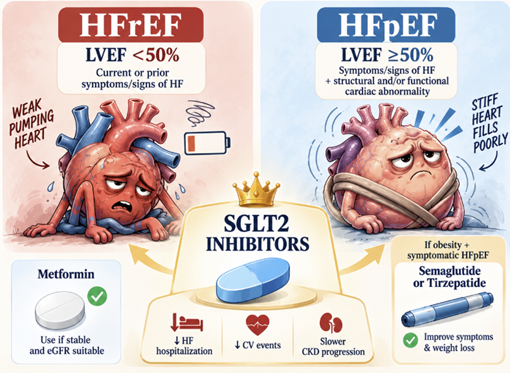
| Phenotype | Typical LVEF | Diabetes treatment implication |
|---|---|---|
| HFrEF | ≤40% | SGLT2 inhibitor has a central role as part of heart-failure GDMT. |
| HFmrEF | 41–49% | SGLT2 inhibitors reduce worsening HF; manage similarly to HFpEF/HFrEF according to the full HF profile. |
| HFpEF | ≥50% | SGLT2 inhibitor remains foundational; in obesity-associated symptomatic HFpEF, semaglutide or tirzepatide may add symptom/event benefit. |
1. SGLT2 inhibitors: the default “heart-failure drug” in type 2 diabetes
The ADA Standards of Care 2026 recommend an SGLT2 inhibitor with proven benefit for people with type 2 diabetes and established heart failure — whether the ejection fraction is reduced or preserved — to reduce worsening heart failure and cardiovascular death. This recommendation is independent of HbA1c.
This is the conceptual shift students and clinicians must remember: an SGLT2 inhibitor is no longer merely a glucose-lowering drug. In heart failure it is a disease-modifying cardiorenal therapy.
Dapagliflozin and empagliflozin have outcome data across the heart-failure spectrum. Their glucose-lowering effect diminishes as kidney function falls, but the heart-failure and kidney rationale can persist at lower eGFR thresholds according to the individual product label and guideline context.
Why SGLT2 inhibitors work even when HbA1c is “fine”
- Reduce heart-failure hospitalization
- Lower risk of worsening heart failure
- Provide kidney protection
- Produce modest natriuresis/osmotic diuresis without behaving like a conventional loop diuretic
- Benefit is not dependent on a large fall in glucose
Practical safety points
- Warn about genital mycotic infections and volume depletion.
- Temporarily withhold around major surgery, prolonged fasting or acute severe illness because of ketoacidosis risk.
- Euglycemic DKA can occur; a “normal” glucose does not exclude it.
- Do not routinely stop therapy for a small expected early eGFR dip unless the clinical picture suggests true volume depletion or acute kidney injury.
2. GLP-1–based therapy: the big 2026 HFpEF update
GLP-1 receptor agonists are excellent drugs for weight reduction and atherosclerotic cardiovascular risk reduction, but they should not be treated as substitutes for SGLT2 inhibitors in HFrEF.
The important exception is obesity-associated symptomatic HFpEF. ADA 2026 specifically recommends GLP-1–based therapy with demonstrated heart-failure benefit in adults with type 2 diabetes, obesity and symptomatic HFpEF. This includes a dual GIP/GLP-1 receptor agonist with demonstrated benefit and a GLP-1 receptor agonist with demonstrated benefit.
In practical terms, semaglutide and tirzepatide have moved into the HFpEF conversation because obesity is often a major driver of congestion, impaired exercise capacity and symptom burden. Their value here is not simply “better sugar”; substantial weight loss can modify the HFpEF phenotype itself.
| Insulin safety rule: Exam pearl: SGLT2 inhibitor = benefit in HFrEF + HFpEF. Semaglutide/tirzepatide = especially relevant in obesity-associated symptomatic HFpEF. |
3. Metformin: no longer forbidden in stable heart failure
The historical fear of metformin in every patient with heart failure is outdated. ADA 2026 states that metformin may be continued in people with type 2 diabetes and stable heart failure if eGFR remains above 30 mL/min/1.73 m².
The key word is stable. Avoid or temporarily withhold metformin in unstable or hospitalized heart failure when tissue hypoperfusion, hypoxemia, shock, acute kidney injury or rapidly changing renal function increases the risk of lactic acidosis.
4. Drugs that should make you uncomfortable in heart failure
| Drug/class | HF issue | Practical position | Memory line |
|---|---|---|---|
| Pioglitazone / TZDs | Fluid retention and edema; can precipitate/worsen HF | Avoid in symptomatic HF | “TZD retains fluid.” |
| Saxagliptin | Signal for increased HF hospitalization in SAVOR-TIMI 53 | Prefer alternatives in established HF | “Saxa? Step back in HF.” |
| Alogliptin | Regulatory warning regarding HF risk, especially in patients with heart/kidney disease | Use caution; alternatives usually available | Do not choose it for a HF advantage. |
| Insulin | Necessary when indicated, but may promote weight gain and sodium retention | Use when needed; do not mistake it for HF-protective therapy | Controls glucose, not HF outcomes. |
| Sulfonylureas | Hypoglycemia and weight gain; no proven HF benefit | Can lower glucose but usually not preferred when cardiorenal options are available | A1c drug, not a HF drug. |
So which diabetes drugs are best in heart failure?
| Clinical situation | Best glucose-lowering direction | Why | Priority |
|---|---|---|---|
| T2DM + HFrEF | SGLT2 inhibitor | Reduces worsening HF/CV death; part of GDMT | ★★★★★ |
| T2DM + HFpEF | SGLT2 inhibitor | Reduces worsening HF; improves quality of life | ★★★★★ |
| T2DM + obesity + symptomatic HFpEF | SGLT2 inhibitor + consider semaglutide/tirzepatide | Targets HF risk plus obesity-driven symptoms/events | ★★★★★ |
| Stable HF needing additional glycemic control | Metformin if eGFR >30; GLP-1–based therapy as phenotype dictates | Reasonable glucose control with broader cardiometabolic benefits | ★★★–★★★★ |
| Symptomatic HF | Avoid TZDs | Fluid retention can worsen HF | AVOID |
Two cases that make the algorithm stick
Case 1: Diabetes + HFrEF
A 62-year-old man has type 2 diabetes, HbA1c 7.0%, eGFR 58 mL/min/1.73 m² and LVEF 32%. He is already receiving guideline-directed HFrEF therapy.
Best diabetes-direction: include an SGLT2 inhibitor with proven HF benefit, even though HbA1c is already near target. Do not wait for poor glycemic control to “justify” it.
Case 2: Diabetes + obesity + HFpEF
A 59-year-old woman has type 2 diabetes, BMI 37 kg/m², exertional dyspnea, edema and symptomatic HFpEF with LVEF 60%.
Best diabetes-direction: an SGLT2 inhibitor remains foundational. If obesity is a major phenotype driver, add or prioritize GLP-1–based therapy with demonstrated HFpEF benefit, such as semaglutide or tirzepatide, when clinically appropriate.
The Marwah Medicine 20-second algorithm
| 1 | Type 2 diabetes + heart failure? | Do not choose therapy from HbA1c alone. |
| 2 | HFrEF or HFpEF? | Use an SGLT2 inhibitor with proven HF benefit unless contraindicated. |
| 3 | Obesity + symptomatic HFpEF? | Consider semaglutide or tirzepatide in addition to the HF strategy. |
| 4 | Stable HF + metformin already working? | It can generally be continued if eGFR >30. |
| 5 | Pioglitazone/TZD? | Avoid in symptomatic HF because of fluid retention. |
| 6 | Need more glucose lowering? | Choose agents around CKD, ASCVD, weight, hypoglycemia risk and patient factors — not glucose alone. |
Exam-ready takeaways
- SGLT2 inhibitors are recommended in type 2 diabetes with established HFrEF or HFpEF, irrespective of HbA1c.
- For obesity-associated symptomatic HFpEF, GLP-1–based therapy with proven benefit — particularly semaglutide or tirzepatide — now has a specific role.
- Metformin can be continued in stable HF if eGFR >30 mL/min/1.73 m²; avoid it in unstable/hospitalized HF with hypoperfusion or acute organ dysfunction.
- Thiazolidinediones can worsen HF through fluid retention.
- Saxagliptin has an HF-hospitalization signal and is generally not a preferred DPP-4 inhibitor in established HF.
- Treat the phenotype: HFrEF, HFpEF, obesity, CKD and ASCVD matter as much as the HbA1c.
Frequently asked questions
Which diabetes drug is best for a patient with HFrEF?
An SGLT2 inhibitor with proven heart-failure benefit is the key glucose-lowering class because it improves HF outcomes independent of HbA1c.
Which diabetes drug is best for HFpEF?SGLT2 inhibitors are foundational. In patients with obesity and symptomatic HFpEF, semaglutide or tirzepatide may provide additional symptom and HF-event benefit.
Can metformin be used in heart failure?Yes, in stable heart failure when kidney function is adequate (ADA 2026: eGFR >30 mL/min/1.73 m²). Avoid it during unstable or hospitalized HF with hypoperfusion, hypoxemia or acute kidney injury.
Is pioglitazone contraindicated in heart failure?Thiazolidinediones cause fluid retention and should be avoided in symptomatic heart failure.
Do I need a high HbA1c before starting an SGLT2 inhibitor for HF benefit?No. The heart-failure recommendation is independent of HbA1c and independent of whether additional glucose lowering is needed.
Do GLP-1 drugs replace SGLT2 inhibitors in HFrEF?No. The HF outcome evidence for SGLT2 inhibitors is foundational in HFrEF. GLP-1–based therapy may be added for weight, ASCVD and other metabolic indications, but it is not a substitute for HFrEF guideline-directed therapy.
CLINICAL BOTTOM LINE
In diabetes with heart failure, stop asking only “What lowers HbA1c?” Ask “What keeps this patient out of the hospital and protects the heart and kidneys?”
Key references and 2026 guidance
- American Diabetes Association Professional Practice Committee. Pharmacologic Approaches to Glycemic Treatment: Standards of Care in Diabetes—2026. Diabetes Care. 2026;49(Suppl 1):S183–S215.
- American Diabetes Association Professional Practice Committee. Cardiovascular Disease and Risk Management: Standards of Care in Diabetes—2026. Diabetes Care. 2026;49(Suppl 1):S216–S245.
- American Diabetes Association / European Association for the Study of Diabetes. Management of Type 2 Diabetes, 2026: Consensus Report.
- American Diabetes Association. Pharmacologic Treatment of Obesity in Adults: Standards of Care in Overweight and Obesity. 2026.
- McMurray JJV, et al. Dapagliflozin in Patients with Heart Failure and Reduced Ejection Fraction (DAPA-HF). N Engl J Med. 2019.
- Anker SD, et al. Empagliflozin in Heart Failure with a Preserved Ejection Fraction (EMPEROR-Preserved). N Engl J Med. 2021.
- Solomon SD, et al. Dapagliflozin in Heart Failure with Mildly Reduced or Preserved Ejection Fraction (DELIVER). N Engl J Med. 2022.
- Kosiborod MN, et al. Semaglutide in Patients with Heart Failure with Preserved Ejection Fraction and Obesity (STEP-HFpEF). N Engl J Med. 2023.
Editorial note: This article is for medical education. Drug selection and dosing should be individualized to current renal function, hemodynamic status, comorbidities, product labeling and local guidelines.
Other Related Links
- All Posts
- Antibiotics
- CLINICAL CASE QUESTIONS
- COPD
- COVID-19
- Etiquette
- FMGE
- GIST
- INICET
- Medical
- Medicine
- Medicine classes
- NEET
- NEET PG
- NEET PG 2025
- NEETPG2024
- NEETSS
- NExT
- NExT Exam
- Nymphomania
Metformin and Kidney Function Home Metformin and Kidney Function Metformin and Kidney Function eGFR Cutoffs, Dose Reduction and When to Stop — 2026 Practical Guide...
Diabetes and Sexual Health Home Diabetes and Sexual Health Diabetes and Sexual Health Erectile Dysfunction, Low Libido and Female Sexual Dysfunction — A Practical 2026...
Semaglutide vs Tirzepatide for Type 2 Diabetes and Obesity Home Semaglutide vs Tirzepatide for Type 2 Diabetes and Obesity Semaglutide vs Tirzepatide for Type 2...
When to Start Insulin in Type 2 Diabetes Home When to Start Insulin in Type 2 Diabetes When to Start Insulin in Type 2 Diabetes:...
Finerenone in Diabetic Kidney Disease Home Finerenone in Diabetic Kidney Disease Finerenone in Diabetic Kidney Disease Who should get it in 2026? The diabetic patient...
Diabetes Treatment Guidelines 2026 Home Diabetes Treatment Guidelines 2026 Diabetes Treatment Guidelines 2026: Is Metformin Still First-Line? A practical, evidence-based guide to choosing therapy by...