
DKA, HHS & Lactic Acidosis in Diabetes Home DKA, HHS & Lactic Acidosis in Diabetes DKA, HHS & Lactic Acidosis in Diabetes Which is better...
Finerenone in Diabetic Kidney Disease
- Home
- Finerenone in Diabetic Kidney Disease
Finerenone in Diabetic Kidney Disease
Who should get it in 2026?
The diabetic patient whose HbA1c looks fine - but kidneys keep getting worse
Consider a patient with type 2 diabetes. HbA1c is 6.9%, blood pressure is controlled, an ARB is already on board, and empagliflozin has been added. Everything appears to be moving in the right direction – but the urine albumin-creatinine ratio (UACR) remains 450 mg/g.
This is the patient in whom we need to stop thinking only about glucose. Persistent albuminuria represents persistent cardiorenal risk, even when glycemic control looks respectable.
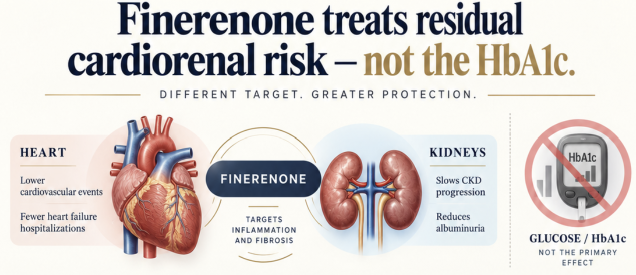
Current diabetes and kidney disease guidance supports a nonsteroidal mineralocorticoid receptor antagonist (nsMRA) with proven benefit in appropriate patients with type 2 diabetes, chronic kidney disease and albuminuria, provided kidney function and serum potassium permit safe initiation.
What exactly is finerenone?
Finerenone is a nonsteroidal mineralocorticoid receptor antagonist. It should not be mentally treated as simply “another spironolactone.” The clinically important point is that finerenone has dedicated kidney and cardiovascular outcome data in patients with type 2 diabetes and CKD.
Its role is not primarily glucose lowering. It is better understood as one layer in modern cardiorenal protection:
- ACE inhibitor/ARB: reduces intraglomerular pressure and treats hypertension/albuminuria.
- SGLT2 inhibitor: provides powerful kidney and cardiovascular protection through metabolic and hemodynamic pathways.
- Finerenone: blocks pathologic mineralocorticoid receptor signaling, targeting inflammatory and fibrotic pathways.
The modern strategy is therefore not to ask one drug to do everything, but to combine complementary disease-modifying therapies when clinically appropriate.
Who is the ideal patient for finerenone?
The classic patient is someone with type 2 diabetes, albuminuric CKD and persistent cardiorenal risk despite optimized renin-angiotensin system blockade.
T2DM + albuminuric CKD + ACEi/ARB + acceptable potassium + eGFR ≥25 = Think FINERENONE
In practice, an SGLT2 inhibitor is also usually part of the kidney-protective regimen when it is indicated and tolerated. Finerenone is especially attractive when albuminuria persists despite these foundational measures.
Do not wait for serum creatinine to become dramatically abnormal. Albuminuria itself is a powerful marker of future kidney and cardiovascular risk.
The 2026 shift: think combination cardiorenal therapy
A key contemporary change is the move away from excessively slow, sequential treatment. In selected patients already receiving renin-angiotensin system inhibition, an SGLT2 inhibitor and finerenone may be considered together rather than waiting for years of progressive albuminuria before adding the next protective pathway.
The CONFIDENCE trial directly evaluated finerenone plus empagliflozin and showed a substantially greater fall in albuminuria with combination therapy than with either drug alone. This supports a “layered protection” model that increasingly resembles modern heart failure treatment.
Do not wait for one protective pathway to “fail” before activating another.
Finerenone dosing made simple
| eGFR (mL/min/1.73 m²) | Starting dose |
|---|---|
| ≥60 | 20 mg once daily |
| 25 to <60 | 10 mg once daily |
| <25 | Do not initiate |
Memory rule: 60 → 20 mg | 25–60 → 10 mg | Below 25 → do not start
Potassium decides whether you can play the game
Hyperkalemia is the major practical limitation. Serum potassium should be checked before treatment, after initiation or dose adjustment, and periodically thereafter.
A practical monitoring framework is:
| Serum K+ | Practical action |
|---|---|
| >5.0 mEq/L before initiation | Do not initiate finerenone |
| ≤4.8 mEq/L during therapy | Dose may be increased from 10 mg to 20 mg if otherwise appropriate |
| >4.8 to 5.5 mEq/L | Usually maintain current dose and monitor |
| >5.5 mEq/L | Withhold finerenone; reassess potassium |
| When K+ falls to ≤5.0 mEq/L | Consider restarting at 10 mg |
Kidney function allows it. Potassium controls it.
What did FIDELIO-DKD show?
FIDELIO-DKD was the landmark kidney-outcome trial. Patients with type 2 diabetes and CKD received finerenone or placebo on top of optimized ACE inhibitor or ARB therapy. Finerenone significantly reduced the risk of kidney disease progression and also improved cardiovascular outcomes.
The exam-friendly message is simple: FIDELIO-DKD established finerenone as a kidney-protective therapy in diabetic CKD.
What did FIGARO-DKD show?
FIGARO-DKD enrolled a broader CKD population and focused primarily on cardiovascular outcomes. Finerenone reduced the composite cardiovascular endpoint, with an important contribution from fewer hospitalizations for heart failure.
FIDELIO = kidney signal. FIGARO = cardiovascular signal. Together = cardiorenal protection
Finerenone versus spironolactone: are they interchangeable?
No. Both block the mineralocorticoid receptor, but the evidence base is not interchangeable. Spironolactone remains highly useful for resistant hypertension and heart failure, among other indications. Finerenone, however, has dedicated outcome evidence for chronic kidney disease associated with type 2 diabetes.
So when an exam or clinical discussion asks which MRA has proven kidney and cardiovascular outcome benefit specifically in diabetic CKD, the answer is finerenone.
Does finerenone replace an SGLT2 inhibitor?
No. That is the wrong comparison. These drugs act through complementary pathways. In contemporary diabetic CKD care, treatment is increasingly layered: renin-angiotensin system blockade, SGLT2 inhibition, finerenone, and – in appropriate patients – GLP-1 receptor agonist therapy.
The key conceptual change is this: diabetic kidney disease is no longer treated according to HbA1c alone. A patient may have an excellent HbA1c and still carry substantial residual kidney and cardiovascular risk.
A simple clinical example
A 58-year-old man has type 2 diabetes for 12 years, HbA1c 7.1%, BP 126/76 mmHg, eGFR 52 mL/min/1.73 m², UACR 380 mg/g and serum potassium 4.4 mEq/L. He is already receiving losartan at the maximally tolerated dose and empagliflozin.
Would finerenone be reasonable? Yes. He has diabetic CKD, persistent albuminuria, eGFR above the initiation threshold, acceptable potassium and background RAS blockade.
Starting dose for eGFR 52: finerenone 10 mg once daily. Recheck potassium and renal function in about 4 weeks.
Who should NOT casually receive finerenone?
- Patients with serum potassium above the permitted initiation threshold.
- Patients with eGFR below the recommended initiation threshold.
- Patients taking strong CYP3A4 inhibitors.
- Patients with substantial hyperkalemia risk who cannot undergo appropriate monitoring.
- Patients using potassium supplements or potassium-containing salt substitutes without a clear indication and monitoring plan.
Finerenone is not a “prescribe and forget” medication. It is a disease-modifying drug that requires appropriate surveillance.
The Marwah Medicine take-home algorithm
- Identify type 2 diabetes with chronic kidney disease and albuminuria.
- Use ACE inhibitor or ARB at the maximally tolerated dose when indicated.
- Add an SGLT2 inhibitor for kidney/cardiovascular protection when appropriate.
- If albuminuric cardiorenal risk persists and eGFR is ≥25 with acceptable potassium, think finerenone.
- Monitor potassium and kidney function after initiation and dose changes.
- Consider additional GLP-1 receptor agonist therapy when cardiovascular, metabolic or kidney indications support it.
Finerenone does not treat the sugar. It treats the risk that remains after the sugar has been treated.
Frequently Asked Questions
Can finerenone be used when eGFR is below 30?
Yes. In diabetic CKD, initiation is permitted down to an eGFR of 25 mL/min/1.73 m². Initiation below 25 is not recommended.
What potassium level prevents initiation?
Do not initiate finerenone when serum potassium is above 5.0 mEq/L.
When should potassium be checked after starting?
A practical standard is around 4 weeks after initiation, after dose adjustment, and periodically thereafter depending on risk.
Is finerenone better than an SGLT2 inhibitor?
That is not the useful comparison. Their mechanisms are complementary, and selected patients benefit from layered therapy.
Does finerenone lower HbA1c?
Its major clinical role is kidney and cardiovascular protection, not glycemic control.
What are the landmark finerenone trials?
FIDELIO-DKD and FIGARO-DKD; the CONFIDENCE trial later provided important evidence for finerenone plus empagliflozin combination therapy.
Clinical bottom line
T2DM + CKD + albuminuria + eGFR ≥25 + acceptable K+ + ACEi/ARB = THINK FINERENONE
In selected patients with persistent albuminuric risk, especially those already on RAS blockade, modern therapy increasingly combines complementary kidney-protective pathways instead of waiting for preventable deterioration.
Key references
- American Diabetes Association. Standards of Care in Diabetes – 2026: Chronic Kidney Disease and Risk Management.
- American Diabetes Association. Standards of Care in Diabetes – 2026: Pharmacologic Approaches to Glycemic Treatment.
- Finerenone (Kerendia) prescribing information. U.S. Food and Drug Administration.
- Bakris GL, et al. Effect of Finerenone on Chronic Kidney Disease Outcomes in Type 2 Diabetes (FIDELIO-DKD). New England Journal of Medicine.
- Pitt B, et al. Cardiovascular Events with Finerenone in Kidney Disease and Type 2 Diabetes (FIGARO-DKD). New England Journal of Medicine.
- CONFIDENCE trial: finerenone plus empagliflozin in chronic kidney disease and type 2 diabetes.
Educational disclaimer: This article is intended for medical education. Treatment must be individualized according to current guidelines, product labeling, kidney function, serum potassium, comorbidities, drug interactions and local prescribing standards.
Other Related Links
- All Posts
- Antibiotics
- CLINICAL CASE QUESTIONS
- COPD
- COVID-19
- Etiquette
- FMGE
- GIST
- INICET
- Medical
- Medicine
- Medicine classes
- NEET
- NEET PG
- NEET PG 2025
- NEETPG2024
- NEETSS
- NExT
- NExT Exam
- Nymphomania
Metformin and Kidney Function Home Metformin and Kidney Function Metformin and Kidney Function eGFR Cutoffs, Dose Reduction and When to Stop — 2026 Practical Guide...
Diabetes and Sexual Health Home Diabetes and Sexual Health Diabetes and Sexual Health Erectile Dysfunction, Low Libido and Female Sexual Dysfunction — A Practical 2026...
Semaglutide vs Tirzepatide for Type 2 Diabetes and Obesity Home Semaglutide vs Tirzepatide for Type 2 Diabetes and Obesity Semaglutide vs Tirzepatide for Type 2...
When to Start Insulin in Type 2 Diabetes Home When to Start Insulin in Type 2 Diabetes When to Start Insulin in Type 2 Diabetes:...
Diabetes and Heart Failure: Best Glucose-Lowering Drugs in HFrEF and HFpEF (2026) Home Diabetes and Heart Failure The mistake: choosing a diabetes drug by HbA1c...
Diabetes Treatment Guidelines 2026 Home Diabetes Treatment Guidelines 2026 Diabetes Treatment Guidelines 2026: Is Metformin Still First-Line? A practical, evidence-based guide to choosing therapy by...